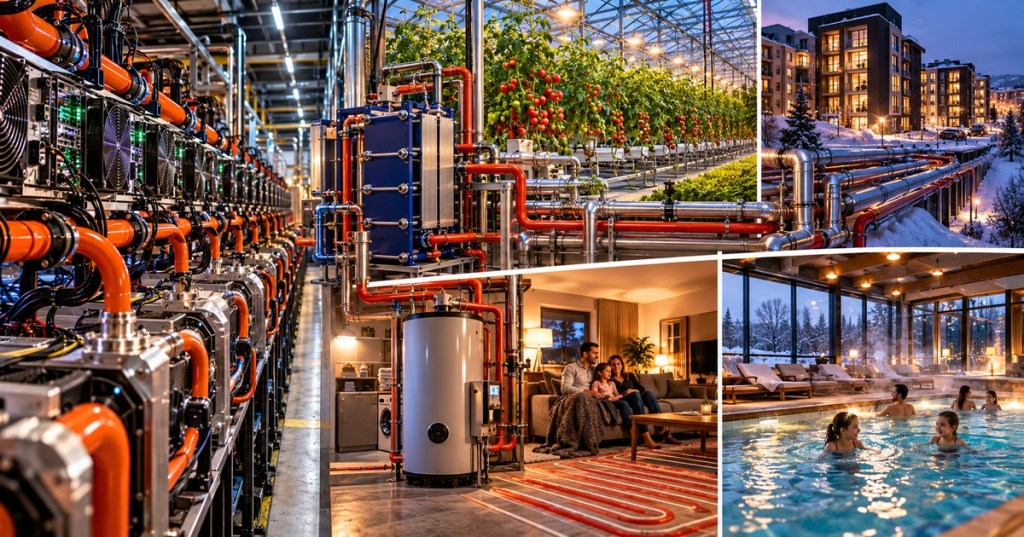
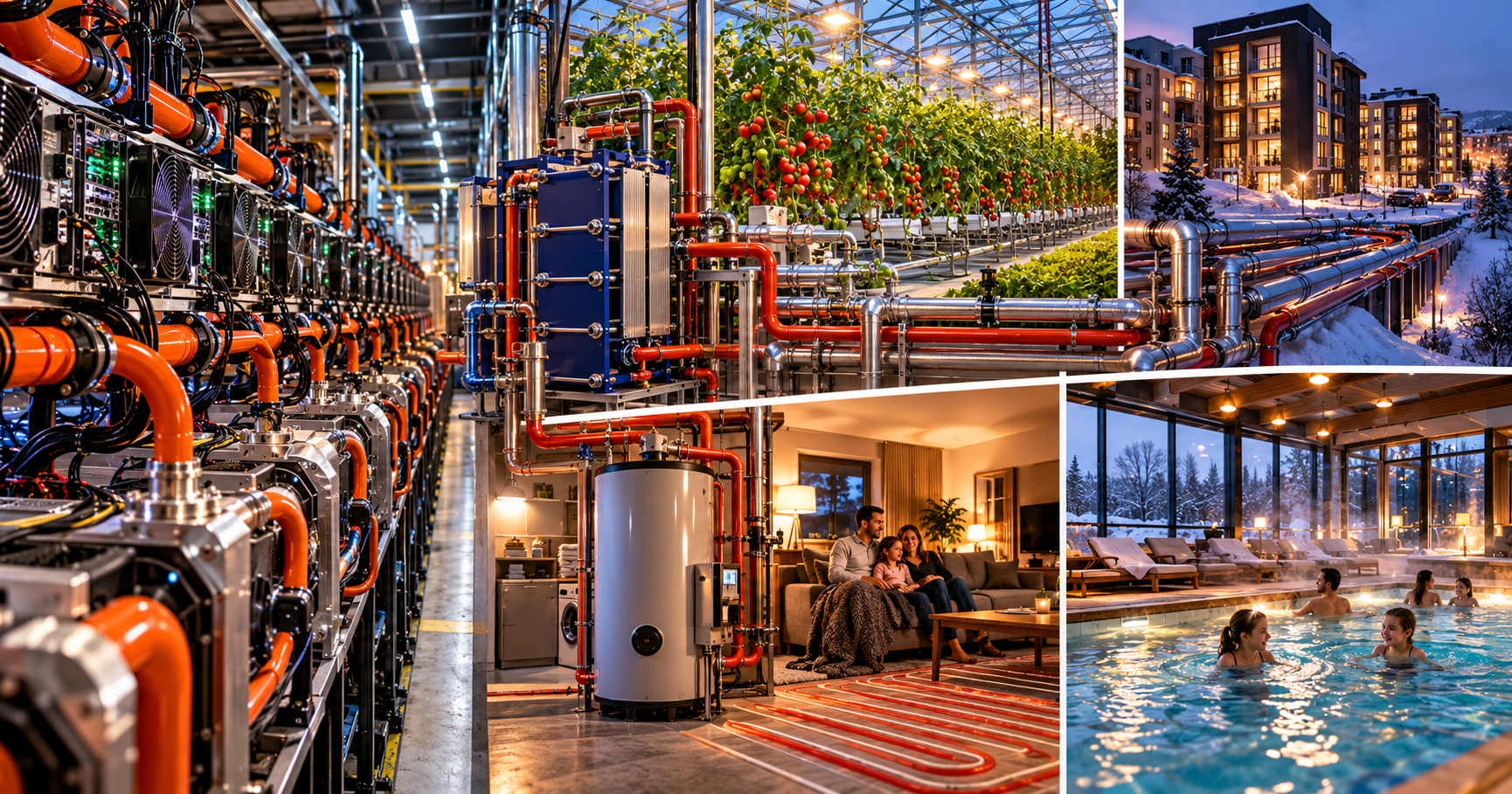
Bitcoin mining machines transform nearly all their electrical input into heat. Usually that thermal energy escapes through exhaust fans or cooling towers. But a growing group of operators is routing it into buildings, agriculture and hot-water systems. Here are seven of the most interesting applications, ranked editorially by practical usefulness, scalability and demonstrated deployment—not by claimed financial returns.
7. Home Water Heaters — Heatbit Bitwater
Heatbit’s Bitwater replaces an electric tank’s heating element with ASIC chips, combining domestic hot-water production and mining. Its initial $899 batch is a preorder targeting Q1 2027, not a proven mass deployment. Read our earlier Bitwater coverage. Mining income is uncertain and the device does not eliminate the electricity bill.
6. Individual Room Heating — Heatbit
Heatbit’s ASIC-powered space heaters circulate mining-generated heat into rooms. Their value is greatest where electric resistance heating would already be used. Unlike heat pumps, mining heaters do not multiply delivered heat per electrical watt; their potential offset is the Bitcoin earned, minus equipment and operating costs.
5. Distillery Process and Storage Heat — MintGreen
MintGreen’s Shelter Point distillery installation uses immersion-cooled miners to warm barrel-storage and process areas. This small-scale industrial example illustrates how waste heat can serve a specific nearby demand rather than requiring long-distance distribution. Reported use does not imply independently audited heat savings. Deployment registry and evidence notes.
4. Bathhouses and Swimming Pools
Warm-water recreation facilities can use continuous low-grade heat. New York’s Bathhouse has publicly discussed mining-powered pool heating; its operator explanation provides direct context. Pool temperatures make this an attractive use case, but the economics depend on equipment uptime, water demand and the previous heating system.
3. Greenhouse Agriculture — Canaan and Bitforest
A January 2026 Canaan announcement describes a 3 MW Manitoba pilot using liquid-cooled Avalon servers to preheat water for a tomato greenhouse. The company targets approximately 90% heat recovery; that is a project target, not independently verified achieved performance. Greenhouses can benefit because they need sustained warmth through cold months.
2. Nordic Hot-Water District Networks — Canaan
Canaan reported an 8 MW Nordic district-heating order in May, including an initial approximately 2 MW phase already operating and a further expansion. Hydro-cooled Avalon equipment reportedly supplies water near 80°C, potentially reducing the need for additional heat-pump temperature boosting. This is a commercial infrastructure application rather than a household gadget.
1. Community District Heating — MARA in Finland
MARA’s 2 MW Finnish pilot delivers recovered compute heat into an established district heating network serving roughly 11,000 residents. The resident figure describes the network served, not proof that mining supplies every resident’s total heat. The important innovation is the integration of a continuously operating compute facility with an existing utility heat customer.
Bottom line: Heat recovery can displace another heating source when demand, temperature and location align. It does not make Bitcoin mining energy-free. Compare the recovered thermal MWh, electricity cost, network difficulty, carbon intensity and displaced fuel before accepting a savings claim. For the broader engineering context, see our Top 7 data-center cooling technologies.
BitcoinVersus.Tech Editor’s Note: Our reporting distinguishes operating installations from announced pilots and preorders. If you value this research, please consider donating 5,000 sats by scanning the QR code below.

Scan this code with your Bitcoin wallet camera, preferably from a desktop or larger screen.


Leave a Reply