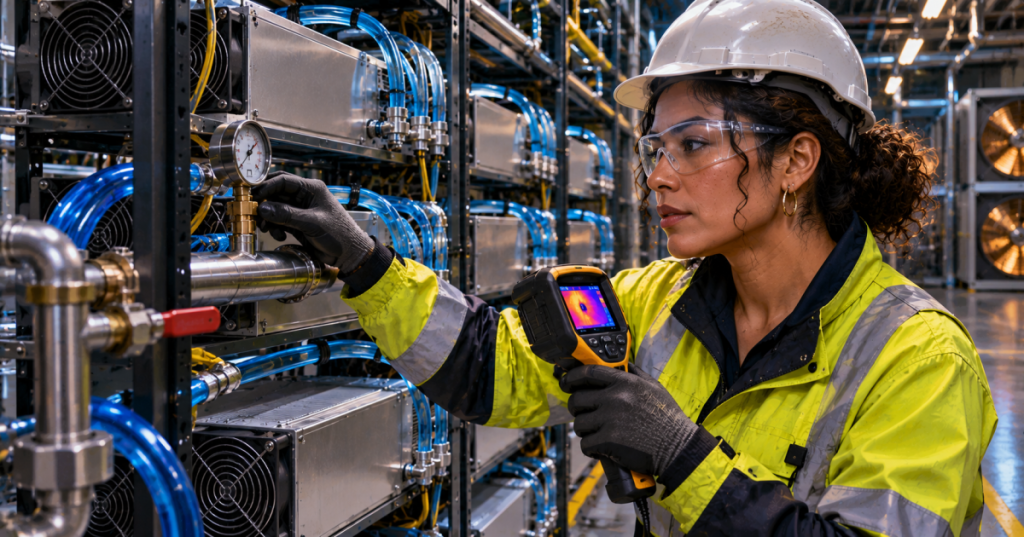
BITMAIN is preparing November 2026 shipments of its ANTMINER S23 XP Hyd., a hydro-cooled Bitcoin miner rated at 600 TH/s and 8.9 joules per terahash (J/TH). Against its S21 XP Hyd.’s 12 J/TH, the new rating implies a substantial electricity reduction per unit of Bitcoin hashrate just as network difficulty reached 148.36 trillion on October 29.
The S23 remains listed as a futures product, not a proven fleet-wide deployment. Its claimed 5,340 watts and 600 TH/s are manufacturer specifications at defined operating conditions; actual results depend on coolant temperature, electrical infrastructure and uptime.
What 8.9 J/TH Saves at Equal Hashrate
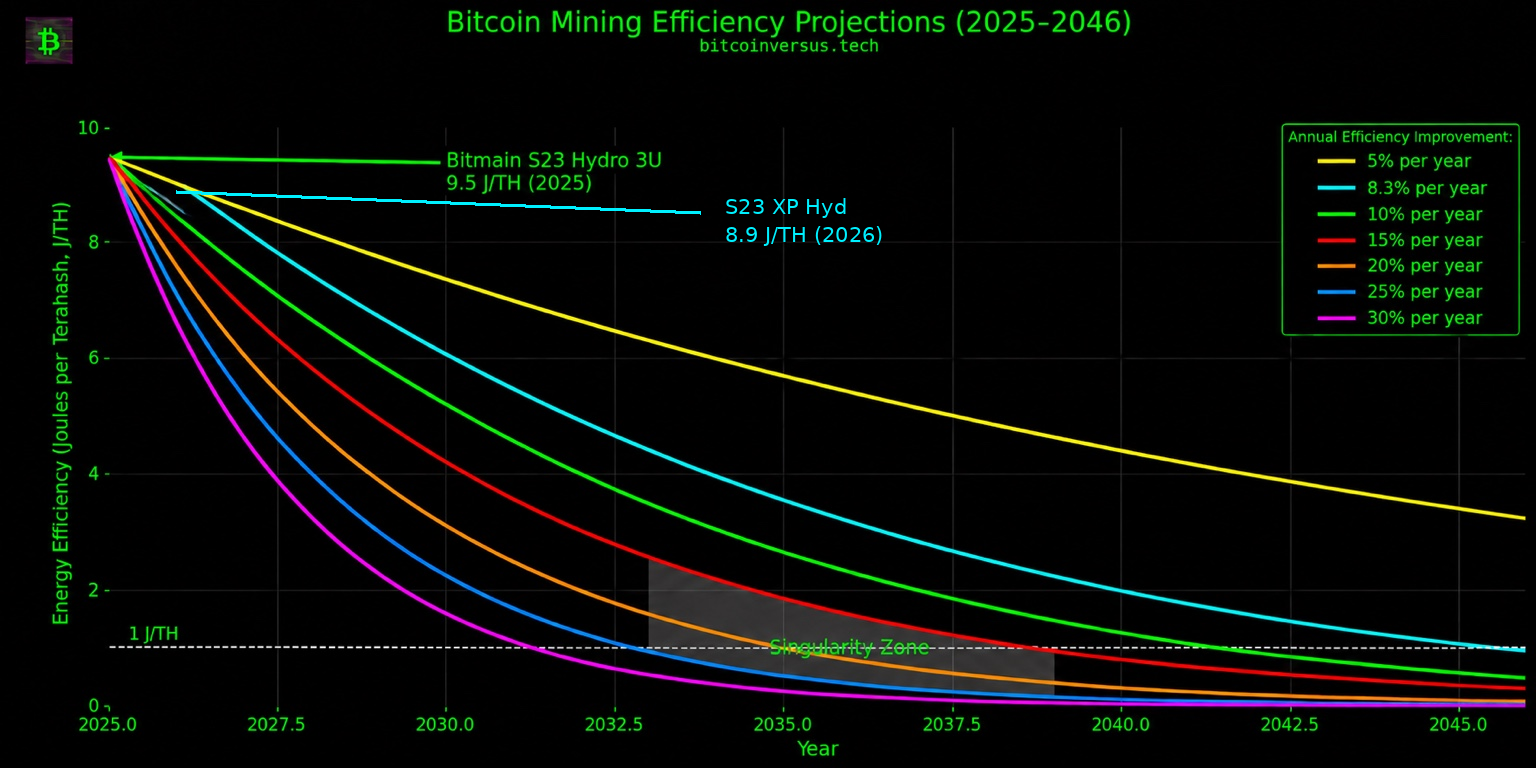
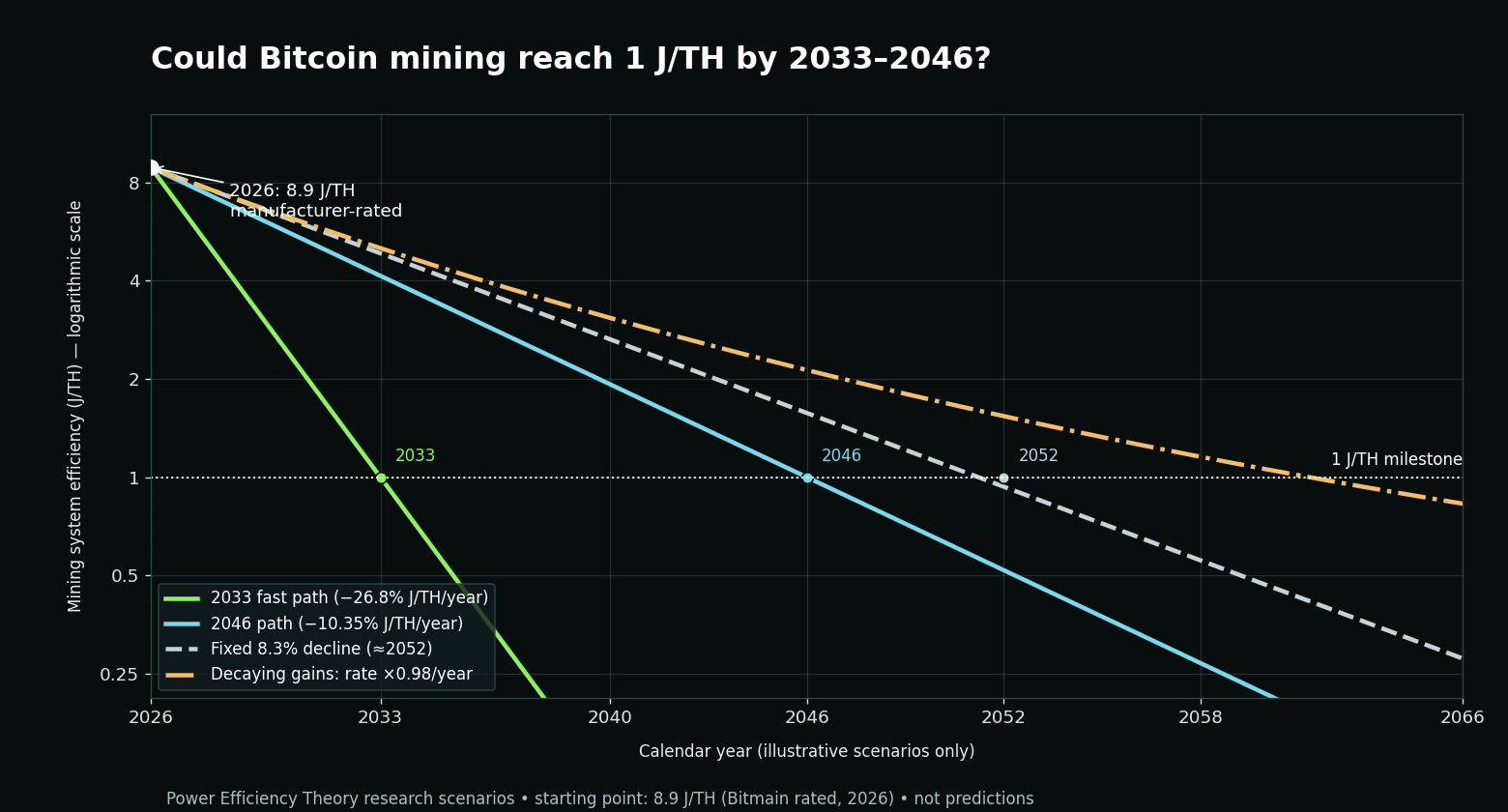
At a constant 1 petahash per second (PH/s), BITMAIN’s ratings imply 8.9 kW for S23-class hardware versus 12 kW for S21 XP Hyd.-class equipment. The difference is 3.1 kW, or 25.8% less miner power for equal work. This comparison normalizes machine count instead of misleadingly comparing one 600 TH/s machine against one 473 TH/s machine. The following original BitcoinVersus charts show hypothetical longer-term J/TH trajectories; they do not plot this article’s annual electricity-cost estimates.
Run that normalized hashrate continuously for 8,760 hours: electricity alone would cost approximately $5,256 versus $3,898 annually at $0.05/kWh—a modeled $1,358 saving. At $0.10/kWh, the modeled saving doubles to $2,716. No mining income or capital payback is assumed.
Why Lower J/TH Does Not Guarantee Profit
BITMAIN’s online list shows the S23 XP Hyd. at $15,300 per unit, compared with $8,041 for the S21 XP Hyd. Those public prices can change and exclude installation costs. The higher upfront cost may consume years of electricity savings; wholesale pricing, cooling systems, financing and repairs change that calculation.
Original @bitcoinversus_ research post discussing an 8.3% annual efficiency-improvement hypothesis. It is a model assumption, not an independent benchmark of S23 hardware.
The original research thread below shows the longer-term 1 J/TH hypothesis. It does not alter the article’s equal-hashrate power calculation.
Original @1BitcoinVersus August 7, 2025 Power Efficiency Theory post outlining a proposed 2033–2039 window for 1 J/TH. Historical research scenario, not a shipment forecast.
Bitcoin difficulty does not alter a rig’s electrical efficiency. Instead, a harder network reduces its expected share of block rewards at unchanged hashrate, reinforcing why hashprice and delivered power cost must be evaluated together. The SEAL04 chip-testing comparison also shows why lab efficiency is not equivalent to wall-power performance.
Next comes shipment evidence and independently reproducible operating data: measured hashrate, miner input power, coolant energy, availability and actual cost per terahash—not a promotional efficiency figure alone.
BitcoinVersus.Tech
BitcoinVersus.Tech Editor’s Note: We volunteer daily to ensure the credibility of the information on this platform is Verifiably True. If you would like to support our work and help further secure the integrity of our research initiatives, please scan the QR code below to donate 5,000 sats. For best results, scan the QR code from a laptop or larger screen.

Bitcoin address: 3C9o19EH5HSiwEPyCTmEKzxhNCbo2X6TTb. On a phone, open the QR image on another screen or copy and verify the address in your wallet before sending.
BitcoinVersus.tech is not a financial advisor. This media platform reports on financial subjects purely for informational purposes.


Leave a Reply