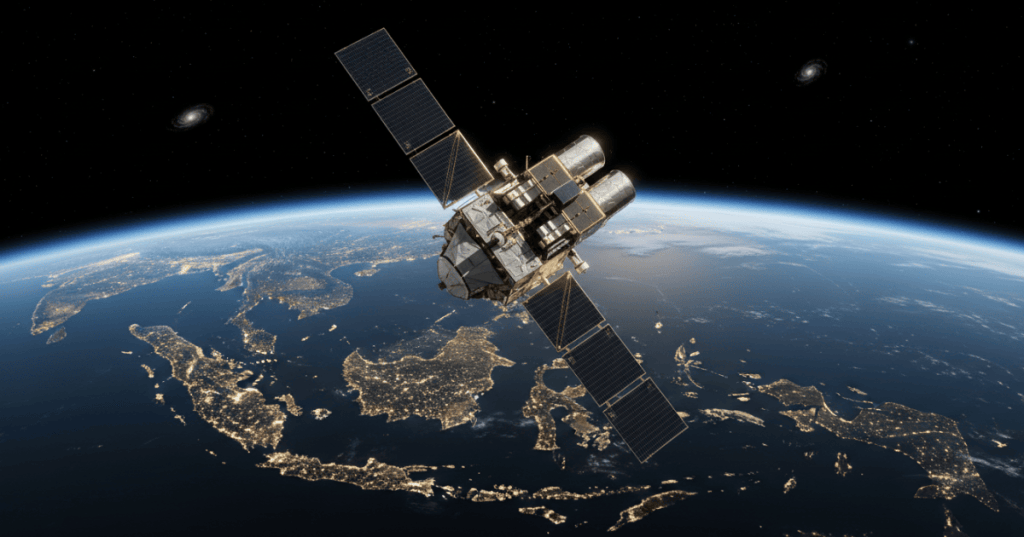
NASA’s Neil Gehrels Swift Observatory re-entered Earth’s atmosphere over northern Sumatra, Indonesia, on November 4, 2026, ending nearly 22 years of observations of gamma-ray bursts, exploding stars and black holes. The satellite, launched in November 2004 for a two-year primary mission, had lost altitude as atmospheric drag increased. NASA confirmed the end of the spacecraft after a planned commercial attempt to raise its orbit failed earlier in the year.
The observatory weighed approximately 3,200 pounds, or 1,450 kilograms. Most of the spacecraft was expected to burn up during re-entry; small dense components may have survived. As of initial reporting, no injuries or damage were reported. The spacecraft’s final descent was a real orbital event, not a simulated exercise or a successful controlled disposal.
NASA Goddard’s 2024 documentary, “What’s In A Name? NASA’s Swift Mission,” explains the observatory’s pointing systems, instruments and scientific history. Source: NASA Goddard on YouTube; archival footage, not the 2026 re-entry.
Two decades watching cosmic explosions
Swift’s defining capability was speed. Its Burst Alert Telescope detected gamma-ray bursts, while the spacecraft quickly repointed X-ray and ultraviolet/optical instruments toward their fading afterglows. NASA says the mission typically could notify other observatories and slew toward a burst in roughly a minute. Researchers then combined observations across wavelengths to investigate the violent processes responsible.
The mission recorded more than 2,000 gamma-ray bursts and over 1,400 supernova explosions, while contributing data to approximately 7,000 scientific papers, according to NASA’s October 23 scientific retrospective. Swift also monitored active galactic nuclei, stellar flares, asteroids and comets. Its archive remains available even though the satellite no longer operates.
Gamma-ray bursts can arise when massive stars collapse or compact stellar remnants merge. Swift’s rapid follow-up helped astronomers distinguish short-lived explosions from longer events and measure their afterglows. New missions such as the Compton Spectrometer and Imager will study related high-energy phenomena, although their observing methods and scientific objectives are not identical.
NASA Goddard’s “NASA Explains Gamma-ray Bursts” describes the explosive phenomena that Swift investigated. Source: NASA Goddard on YouTube, published December 2024.
Why the rescue attempt failed
Swift had no propulsion system capable of countering its gradual orbital decay. A NASA-backed robotic servicing mission by Katalyst Space aimed to capture the telescope and lift it into a higher orbit. The company’s LINK spacecraft launched in July, but a control problem caused an uncontrolled spin and prevented a safe rendezvous. NASA and Katalyst abandoned the planned boost in August.
The failed operation illustrates a difficult engineering challenge: an orbiting spacecraft must match position, velocity and orientation before attempting a mechanical capture. A successful docking demonstration elsewhere does not guarantee compatibility with an older telescope never designed for servicing. BitcoinVersus.Tech previously examined NASA’s proposed commercial Hubble reboost and robotic spacecraft assembly, both relevant to future orbital maintenance.
NASA ended Swift’s scientific operations on October 20 after declining altitude made stable pointing impractical. The agency’s November 2 re-entry notice explained that any surviving fragments could have landed across a broad equatorial latitude band; the final atmospheric-entry location was not known with certainty beforehand. A predicted impact corridor is not evidence of actual debris reaching the ground.
The legacy and the next generation
Swift outlasted its planned lifetime by roughly a factor of eleven, but the loss also underscores the limits of spacecraft without orbit-raising capability. NASA must rely on other telescopes, ground-based follow-up networks and future instruments to preserve rapid-response astronomy. Recent BitcoinVersus.Tech coverage of radiation-tolerant electronics in space offers another perspective on designing hardware for long missions.
The immediate scientific task is to preserve Swift’s observations and maintain alerts for short-lived events. The engineering task is to improve autonomous rendezvous, spacecraft servicing and end-of-life planning before other aging observatories face comparable orbital constraints.
Editor’s Note: NASA’s mission history, October science summary and November re-entry notice are primary sources; Reuters and AP reported the confirmed November 4 atmospheric entry. Both NASA videos are archival educational material, not footage of Swift burning up. The featured image is an original editorial illustration.
To donate 5,000 sats, open this page on another screen and scan the QR code below with your mobile Bitcoin wallet. If your wallet supports scanning a saved image, you can save the QR image and scan it from your phone instead.

We volunteer daily to ensure the information on this platform is Verifiably True. If you would like to support the research, please scan the QR code.


Leave a Reply