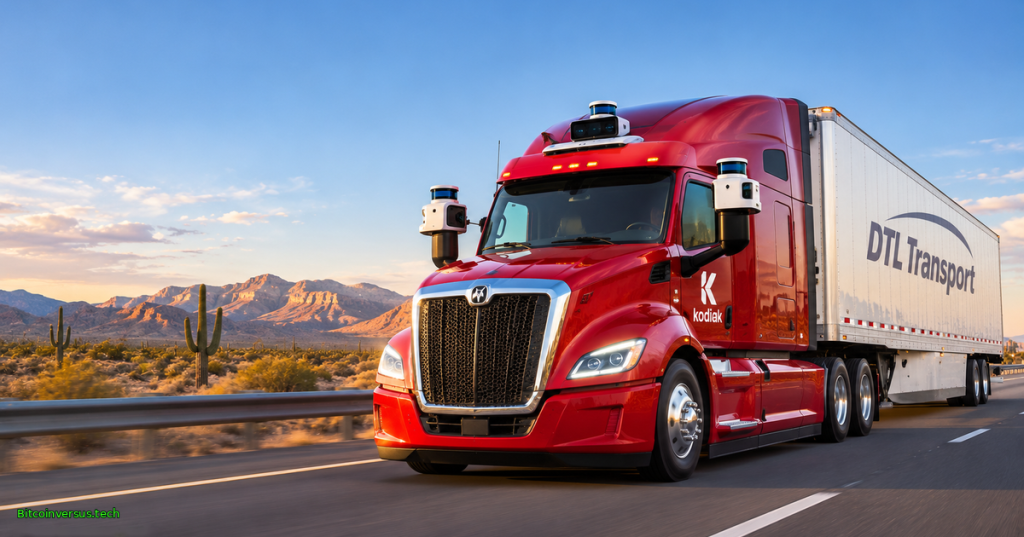
Autonomous freight trucks combine vehicle sensors, onboard computation and driving software to steer, brake and monitor road conditions. California carrier DTL Transport has signed a binding agreement to deploy Kodiak AI’s automated driving system in 75 customer-owned trucks, Kodiak announced October 28, 2026. The carrier will pay Kodiak a per-mile service fee. The agreement marks a meaningful commercial commitment, but does not mean 75 driverless trucks are already operating on public highways.
Kodiak AI, “Kodiak AI Delivers Western Star 49X Driverless Trucks to Atlas Energy Solutions,” November 3, 2026. Official footage shows industrial vehicles delivered to a different customer, Atlas, rather than operating DTL’s future 75-truck fleet.
The 75-Truck Agreement and Its Limits
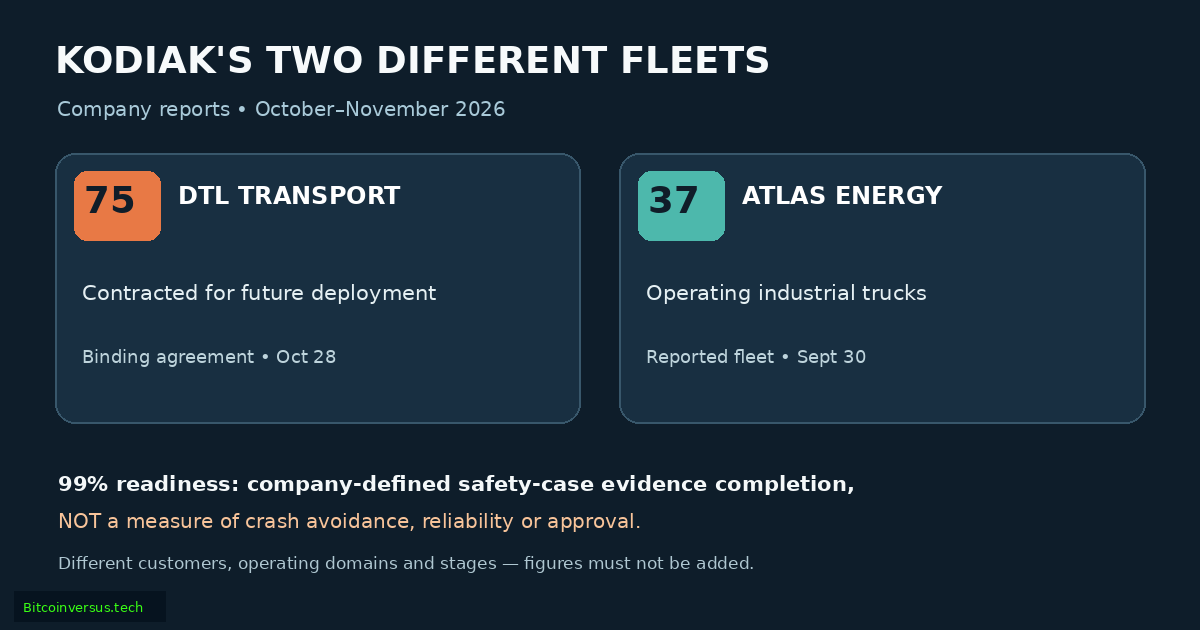
DTL plans routes on Interstate 10 between Dallas and El Paso and Interstate 20 between Dallas and Atlanta, with additional Sun Belt lanes potentially following. The companies previously transported perishable freight over a 225-mile Fresno-to-Los Angeles pilot under California’s heavy-duty autonomous-vehicle testing permit. A human safety driver remained in the cab during the California pilot, according to local reporting. Kodiak has not publicly specified the rate per mile or delivery schedule for the 75-truck commitment.
Kodiak’s existing highway plans are separate from the new agreement. Its earlier Dallas–Houston route announcement described a target for removing the human driver on a freight lane with IKEA. The company still targeted a year-end 2026 launch in its November 5 earnings update. A contract, a supervised pilot, and an unsupervised commercial launch represent different stages of deployment.
37 Trucks Already Operating for Atlas
In the Permian Basin, Atlas Energy Solutions owned and operated 37 Kodiak-equipped driverless trucks by September 30, according to Kodiak. The fleet performs industrial work without anyone in the cab, rather than routine interstate freight service. Kodiak delivered two Western Star 49X vehicles equipped with its seventh-generation driving hardware during September. Gen7 offers approximately 50% more onboard compute than Gen6 by Kodiak’s internal comparison; expected gains in component life remain projections based on stress testing.
Kodiak reported more than 58,000 cumulative paid driverless operating hours and nearly 30,000 delivered loads across its business through the third quarter. The company also reported transporting over 396,000 tons of freight during July–September, more than twice its prior-quarter figure. Cumulative hours and quarterly tonnage describe different periods and should not be treated as interchangeable deployment metrics.
Kodiak AI, “Kodiak Driver at Work in the Forests of Alberta, Canada,” November 5, 2026. Manufacturer video shows autonomous-system field operation in forestry; footage does not demonstrate an unsupervised interstate highway launch.
What the 99% Readiness Figure Means
Kodiak says its Autonomy Readiness Measure (ARM) reached 99% on October 30, up from 96% in September. ARM is the company’s measure of how many claims and supporting evidence items in its structured highway safety case are materially complete. It is not a measured 99% collision-avoidance rate, a probability of safe driving, or a regulatory certification. Completing outstanding validation work remains critical to the planned highway launch. The difference matters alongside broader robot safety-assurance research.
Economics, Competition and Safety
Kodiak reported $2.97 million in third-quarter revenue, versus $770,000 a year earlier, while using $35.2 million of net cash in operating activities during the quarter. The 286% revenue increase included a one-time defense contribution, weakening any inference about recurring freight revenue. With $113.6 million in cash, equivalents and marketable securities at quarter-end, expansion still brings significant financing and execution demands.
Other operators are progressing along different freight-autonomy paths, including Aurora’s autonomous Texas freight operations. Sensor reliability, weather, insurance, regulation and independently evaluated crash performance remain material questions. Fleet-software developers are also offering adjacent physical-AI operational tools; public confidence challenges echo those examined in Waymo’s safety and trust debate. Kodiak’s new agreement signals buyer commitment rather than proof of nationwide driverless capability.
Sources: Kodiak, October 28 agreement; Kodiak, November 5 quarterly results; Kodiak, October 30 safety-case update; Kodiak, November 3 equipment deliveries; and FreightWaves, October 29 independent report.
BitcoinVersus.Tech Editor’s Note
Published November 8, 2026. Contracted DTL trucks, operating Atlas trucks, company-defined safety-case completeness, and planned highway service are separate categories. The 99% metric is not an independent safety rating. Financial data are company-reported Q3 results, with the one-time defense contribution disclosed. The featured 1200 × 630 image is conceptual editorial artwork, not documentary photography of an actual route or vehicle. Both Kodiak-produced videos depict existing operations, not the future DTL deployment. The original in-story comparison graphic distinguishes operating from contracted fleet counts.
We volunteer daily to ensure the information on this platform is Verifiably True. If you would like to support the research, please scan QR code.

Support independent reporting with an optional donation of 5,000 satoshis. Scan the original QR code from a separate screen using a Bitcoin wallet, or use a compatible saved-image scanner on mobile. Verify destination 3C9o19EH5HSiwEPyCTmEKzxhNCbo2X6TTb and the amount before sending.
BitcoinVersus.Tech is not a financial advisor. Financial coverage is provided purely for informational purposes.


Leave a Reply