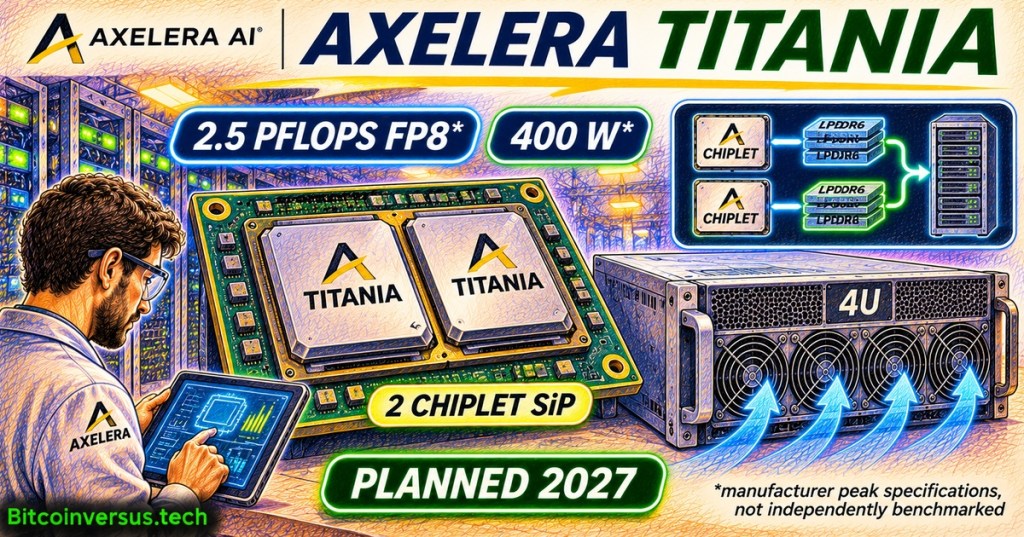
European AI semiconductor company Axelera AI has unveiled Titania, a two-chiplet inference accelerator designed to run large models inside existing air-cooled data centers. Announced November 12, 2026, ahead of the Supercomputing conference in Chicago, the architecture targets operators unable to install power-intensive, liquid-cooled GPU racks. The specifications describe a future product: volume production is planned for the third quarter of 2027, with customer deployments stretching into early 2028.
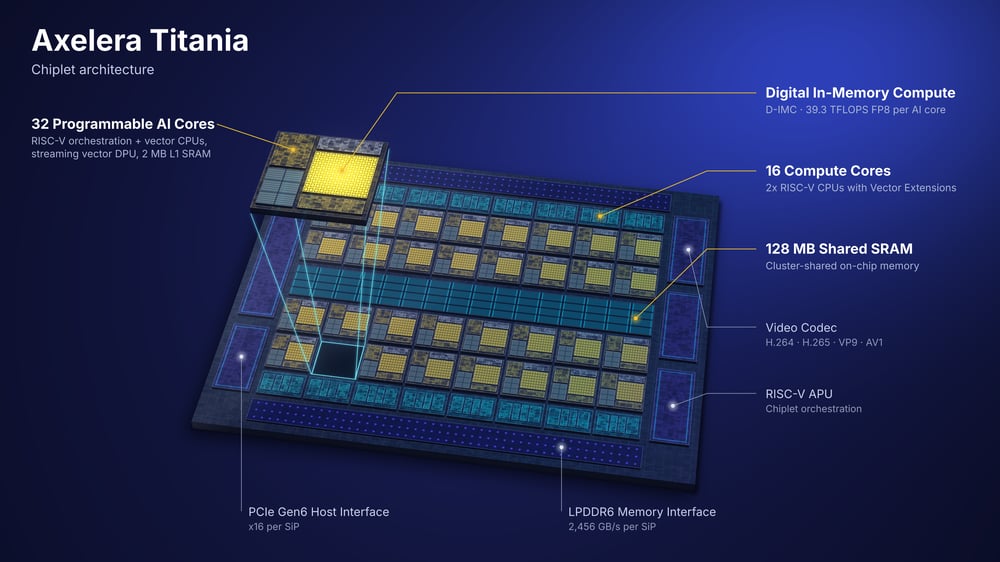
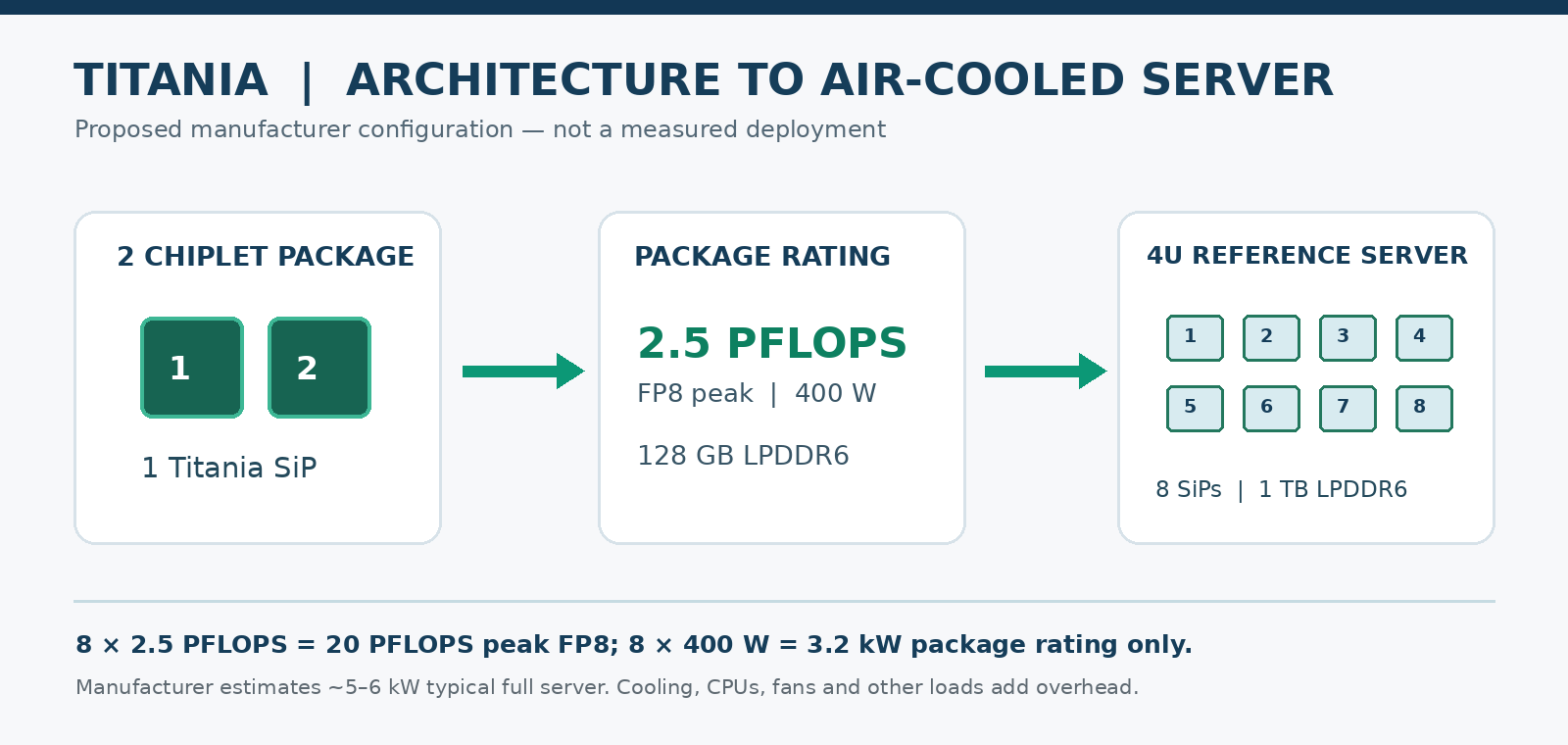
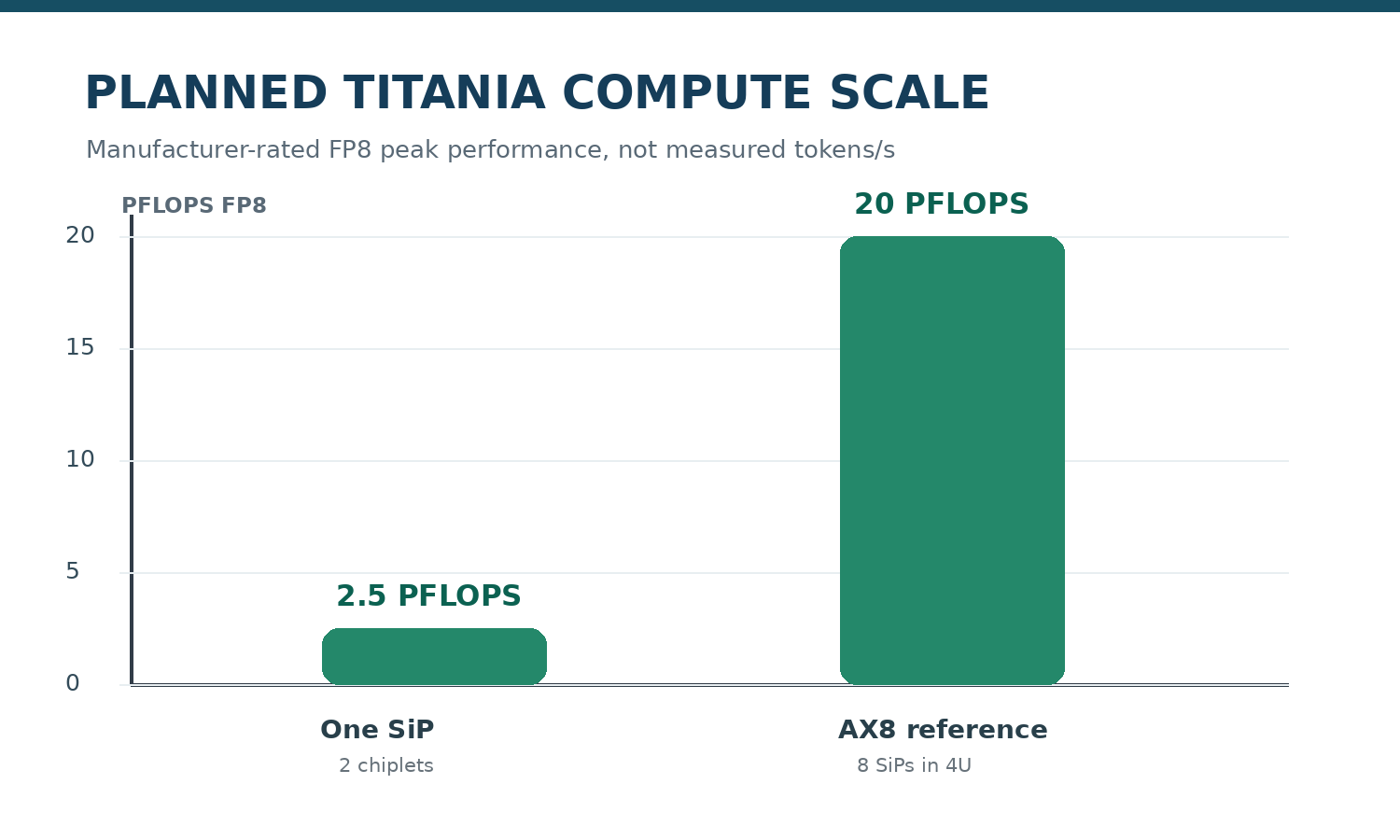
Axelera specifies 2.5 petaflops of peak FP8 compute per system-in-package (SiP) at a 400-watt rating. Each SiP combines two chiplets, 64 programmable AI cores, 128 GB of LPDDR6 memory and a stated 2,458 GB/s memory bandwidth. An eight-package reference server, codenamed AX8, would therefore provide 20 PFLOPS FP8 and 1 TB of accelerator memory in a 4U chassis.
Why Axelera uses LPDDR6 rather than HBM
Titania expands Axelera’s digital in-memory computing approach, which seeks to reduce energy spent moving data between memory and processing units. The design also incorporates programmable RISC-V compute, native low-precision floating-point modes and video-processing blocks. Its architecture is aimed particularly at mixture-of-experts inference, where model weights may occupy considerable memory even though only selected expert networks run for each token.
LPDDR6 differs from the high-bandwidth memory used by many data-center GPUs. It can support a larger capacity strategy at a different cost, energy and bandwidth profile, but LPDDR6 should not be described as faster than HBM in general. Actual performance depends on model architecture, batch size, token generation rate, memory access patterns and software scheduling. The new architecture follows Axelera’s Europa accelerator, which is a separate, earlier product.
A 4U server still needs more than 3.2 kW
Eight packages rated at 400 W produce a combined accelerator rating of 3.2 kW. Axelera estimates that the entire AX8 server would typically draw 5–6 kW, accounting for supporting systems. Power distribution, host processors, memory interfaces, storage, fans and system-level cooling cannot be ignored when comparing rack designs. A 30 kW air-cooled rack could theoretically contain five such servers under the manufacturer’s proposal, subject to actual facility limits.
The company forecasts up to seven times more inference throughput per watt and up to 20 times better total cost of ownership against selected data-center systems. Those figures are Axelera projections, not independently reproduced benchmarks. Its comparison with NVIDIA Vera Rubin-class per-user responsiveness is similarly workload-specific and has not been demonstrated through a neutral production-system test.
Commercial commitments are not delivered machines
Axelera says Titania has more than $300 million in confirmed commitments. Commitments do not establish booked revenue, completed manufacturing or operational customer installations. The company plans PCIe cards and OCP-compliant modules through OEM partners, with both air- and liquid-cooled configurations. Its existing Voyager software environment is intended to help developers migrate workloads from earlier Axelera devices.
Other operators are pursuing different routes to memory and infrastructure efficiency. BitcoinVersus.Tech has covered DDR4 reuse through CXL, multi-megawatt liquid cooling, AI accelerator peak-performance rankings and Vera Rubin infrastructure demonstrations. Peak compute alone cannot establish better economics across incompatible systems.
Bottom line: Titania offers a credible proposed design for AI inference in standard air-cooled racks, but its efficiency, model-serving performance, availability and total ownership costs still require production hardware and independent validation.
Primary sources: Axelera AI announcement, November 12, 2026; manufacturer Titania specifications; official Axelera community product introduction; Futurum Group technical analysis, November 12. Calculations: eight SiPs × 2.5 PFLOPS = 20 PFLOPS peak; eight × 128 GB = 1,024 GB nominal; eight × 400 W = 3.2 kW package ratings. Total server power is reported separately by Axelera.
Editor’s Note: Titania was announced as an architecture planned for production in Q3 2027, not a shipping or independently benchmarked server in November 2026. Advertised FP8 throughput, LPDDR6 bandwidth, system power, model capacity, efficiency and total-cost figures are manufacturer specifications or projections, not independently validated performance. Confirmed commercial commitments must not be equated with realized revenue. The 1200 × 630 colored-pencil featured cover and two in-story explanatory graphics are original editorial illustrations, not photographs of deployed Titania systems. The additional in-story architecture image comes directly from Axelera’s announcement. No exact, relevant official YouTube video with verified playback was established; none is misrepresented as a working embed. Mobile rendering and playback limitations are reported separately.

BitcoinVersus.Tech is volunteer-run and publishes independent educational technology reporting. An optional 5,000-satoshi donation supports ongoing research. Scan the original QR from a second screen with a compatible Bitcoin wallet; on mobile, use a wallet that supports scanning a saved image. Independently verify the recipient address 3C9o19EH5HSiwEPyCTmEKzxhNCbo2X6TTb and the payment amount before sending. Bitcoin transfers are generally irreversible.
We volunteer daily to ensure information on the BitcoinVersus.Tech platform is Verifiably True. Coverage is educational and informational and does not constitute financial or investment advice.


Leave a Reply