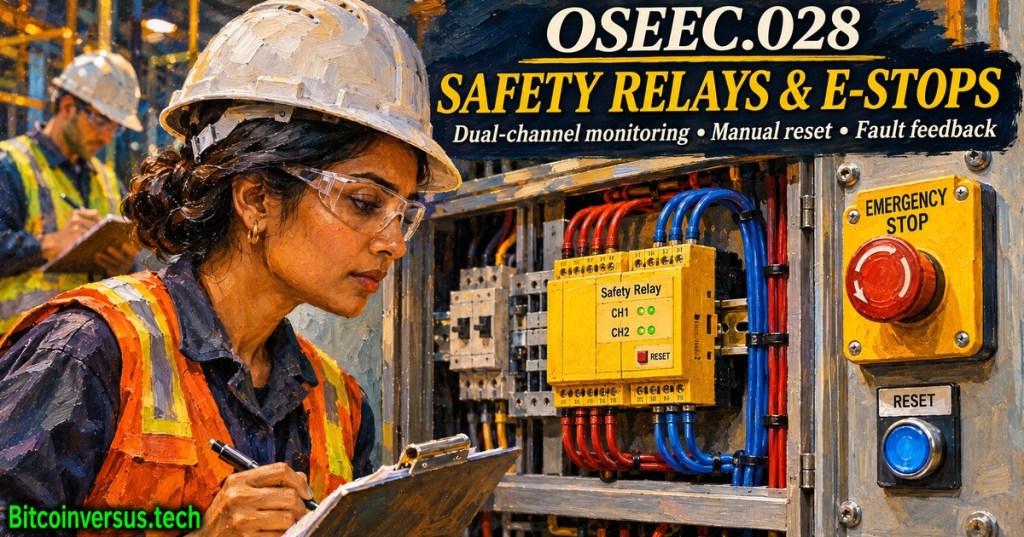
OSEEC.028 examines how industrial safety relays monitor emergency-stop inputs, supervise two independent channels and control the conditions for a safe reset. An ordinary control relay can switch machinery, but a safety-rated function requires a documented machine risk assessment, suitable components, fault detection and validation. The preceding OSEEC.027 mirror-contact lesson covers stuck-output detection; the new chapter focuses on the complete monitored-stop logic.
Joltek / Vlad Romanov, “Understanding Industrial Safety Circuits,” July 23, 2025. The field-focused training discusses emergency stops, redundant channels, reset logic and machine-risk assessment. Credit: Joltek / YouTube; independent instructional material, not manufacturer-approved installation instructions.
Why two channels matter
A conventional emergency-stop actuator can provide two normally closed contact circuits. A compatible safety relay observes their state and may recognize discrepancies, shorts or earth faults according to its selected operating mode and hardware. Pilz’s PNOZ s4, product 750104, for example, supports single- or dual-channel wiring on a 24 V DC supply and provides three normally open safety contacts plus one auxiliary normally closed contact. Its published DC power consumption is 2.5 W. Those specifications describe one model, not every safety relay.
Redundant inputs improve fault tolerance only when the complete design detects relevant failures. Two wires routed through identical vulnerable paths do not automatically create independence; cross-circuit detection is device- and configuration-specific. The Rockwell Automation dual-channel stop documentation makes activation conditional on valid inputs and the correct reset sequence, showing the same general principles implemented in a safety controller.
Reset should never silently restart dangerous motion
A reset input acknowledges restored safety conditions; it must not, by itself, command a hazardous machine to move. Monitored manual reset can require an intentional button transition, rather than accepting a permanently bridged reset signal. Automatic reset is available on some equipment, but suitability depends on the machinery risk assessment and restart prevention. Review robot workcell safety fundamentals before assuming releasing an E-stop makes a guarded area safe.
AboutElectricity, “Wiring safety relay Pilz PNOZ and emergency stop button,” January 13, 2020. A physical hardware demonstration provides visual context only; no wiring should be reproduced without the exact model manual, current standards and competent safety validation. Credit: AboutElectricity / YouTube.
Feedback and validation
Safety outputs often supervise contactors that interrupt power or a drive’s certified safety function. Where the architecture uses external contactors, suitable feedback contacts can prevent re-enabling after a welded or failed switching device. OSEEC.026 explains electrical contact ratings; OSEEC.025 covers coil transient suppression. Neither protective technique substitutes for a correctly validated safety function.
Before commissioning, a qualified team documents the required safety performance, stop behavior, reset conditions, diagnostics and proof-test procedure. Verify that opening each input channel produces the expected safe response, that detected faults inhibit restart and that removing control power leaves the machine in its defined safe condition. Testing must follow manufacturer instructions and an approved isolation and commissioning plan, not an improvised live-panel experiment.
Engineering limit: A dual-channel relay alone cannot guarantee a particular Performance Level, Safety Integrity Level or stopping distance. Sensors, final actuators, wiring, diagnostic coverage, common-cause faults and mechanical stopping characteristics determine the complete safety result. OSEEC.020 provides useful context on ordinary motor-control interlocks, which should not be confused with independently validated safety functions.
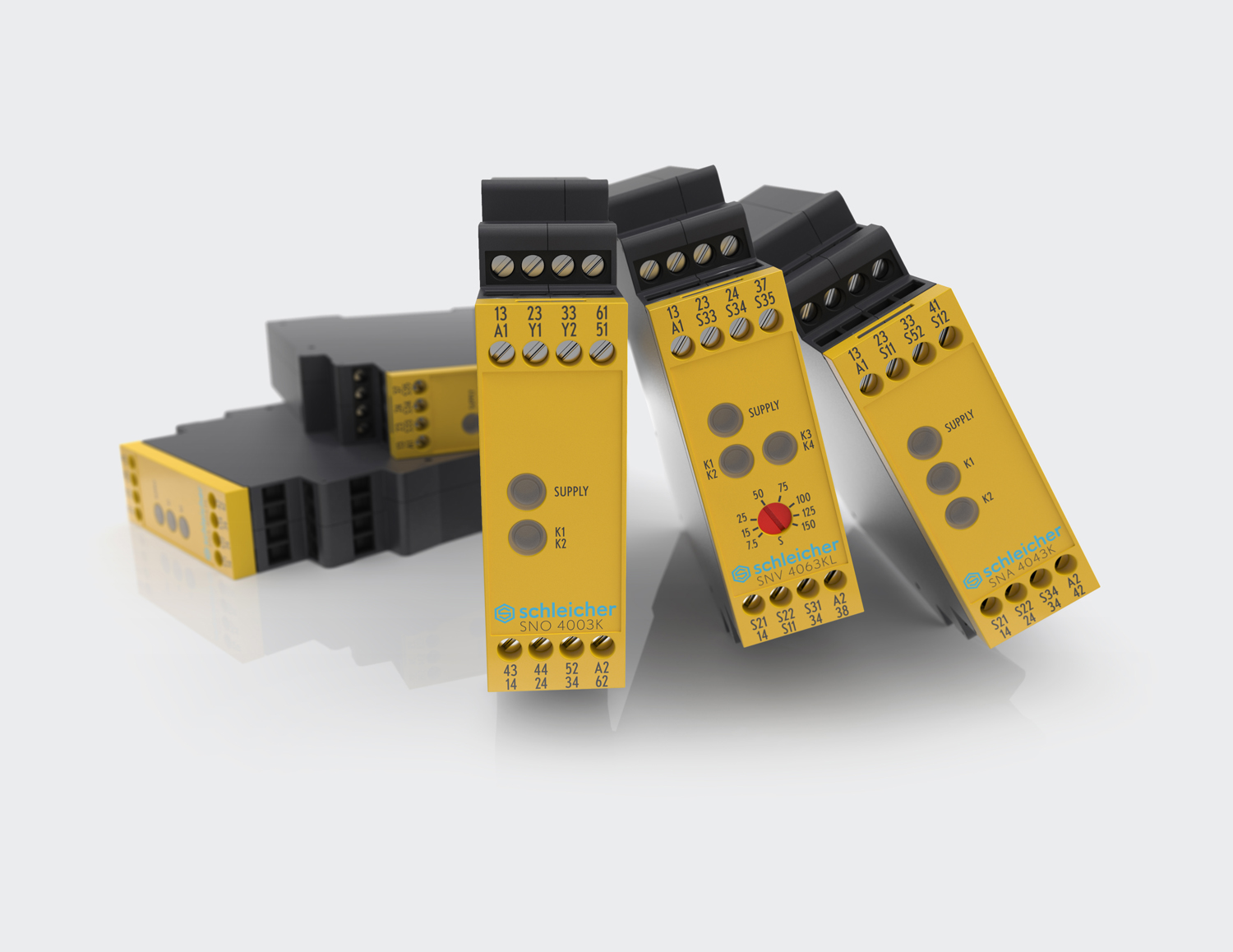
Editor’s Note: Technical descriptions were checked against Pilz and Rockwell Automation product documentation and the published video listings. The 1200 × 630 oil-painting cover is original conceptual artwork with a neon-green Bitcoinversus.tech watermark; the in-story hardware photograph is authentic CC-licensed imagery. No homemade wiring schematic was created. No live emergency-stop circuit, certified validation or physical equipment test was performed; successful WordPress iframe generation does not alone establish playback on every device.

BitcoinVersus.Tech is volunteer-run and publishes independent technical education. An optional 5,000-satoshi donation supports research. Scan the original QR from a second screen using a compatible Bitcoin wallet; on the same phone, use a wallet that supports importing a saved QR image. Independently verify recipient 3C9o19EH5HSiwEPyCTmEKzxhNCbo2X6TTb and amount before sending. Bitcoin transfers are generally irreversible.
We volunteer daily to ensure the information on BitcoinVersus.Tech is Verifiably True. Educational material is not authorization to alter live safety circuits, engineering certification, financial advice or investment advice.


Leave a Reply