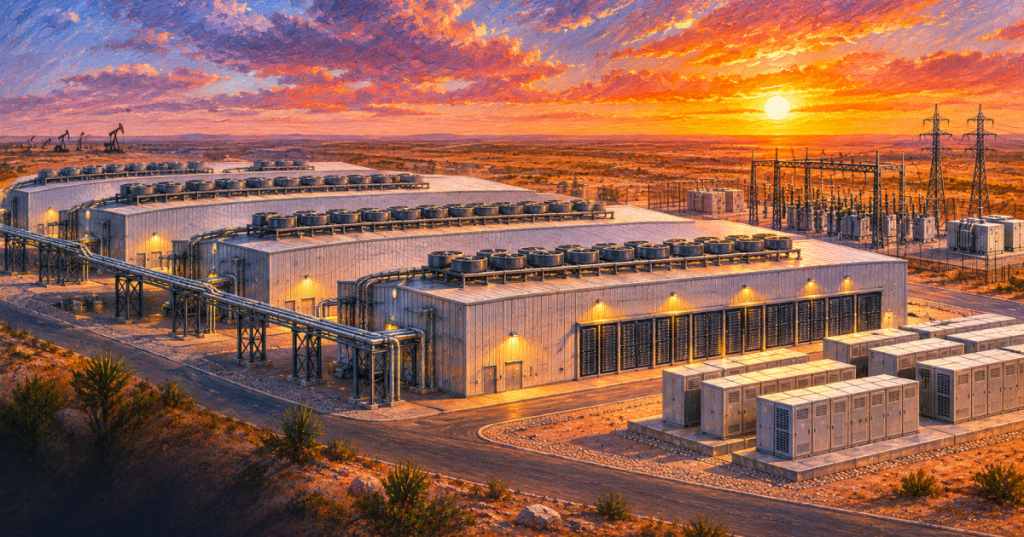
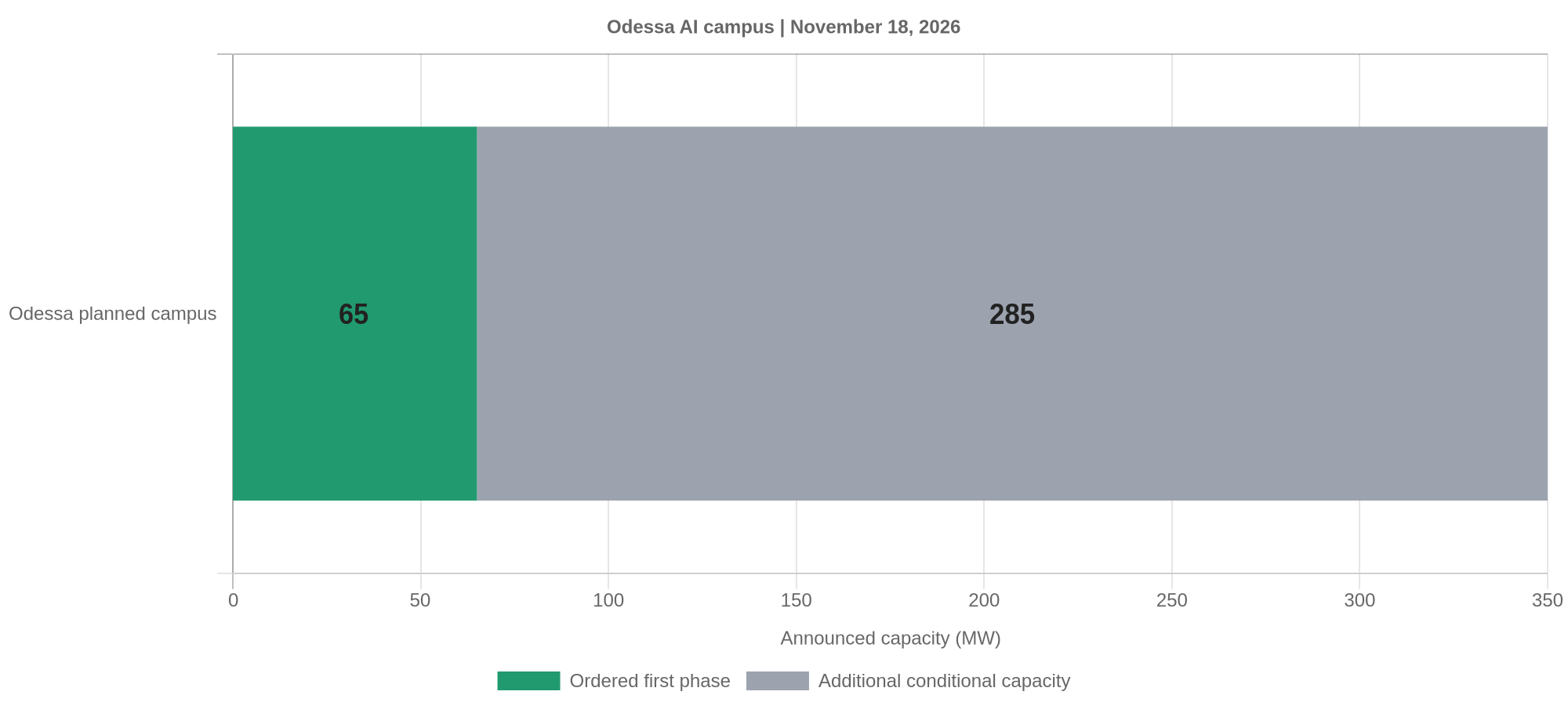
STN One and ChronoScale Holdings closed a joint development transaction on November 18, 2026, for an artificial intelligence campus in Odessa, Texas. An amended SEC filing confirms the partnership closing. The first customer order covers 65 MW of planned capacity, while further orders could expand the development to 350 MW. The agreement illustrates how AI computing is changing West Texas industrial infrastructure, a region also hosting facilities such as Cipher’s Odessa Bitcoin mine, a separate project.
Only 65 MW of the planned deployment has been ordered
ChronoScale’s November 18 announcement identifies an unnamed frontier AI laboratory as the customer for the initial phase, targeted for the first half of 2027. The remaining 285 MW depends on additional orders, financing, infrastructure availability and approvals. Consequently, the first order represents approximately 18.6% of the announced 350 MW deployment. Neither figure should be treated as currently energized IT load.
The partners each agreed to provide $390 million of value for equal ownership. ChronoScale separately announced a financing package combining $250 million of equity with a convertible preferred facility of up to $500 million. The facility is subject to draw conditions; the headline financing amount is not equivalent to cash already invested in construction. Our report on Giga Energy’s Project Clay examines another Texas AI infrastructure agreement with a different commercial structure.
Modular data halls shorten construction dependencies
STN’s campus field report describes its first factory-built facility as designed for 2 MW and 1,024 NVIDIA B300 GPUs. Construction started in May, the building arrived June 11, and commissioning was completed July 31 according to the developer. That chronology applies to the first module, not the delivery schedule for the entire campus. Manufacturing buildings while site preparation proceeds can reduce sequential dependencies, but electrical connections, network installation and commissioning still require coordination.
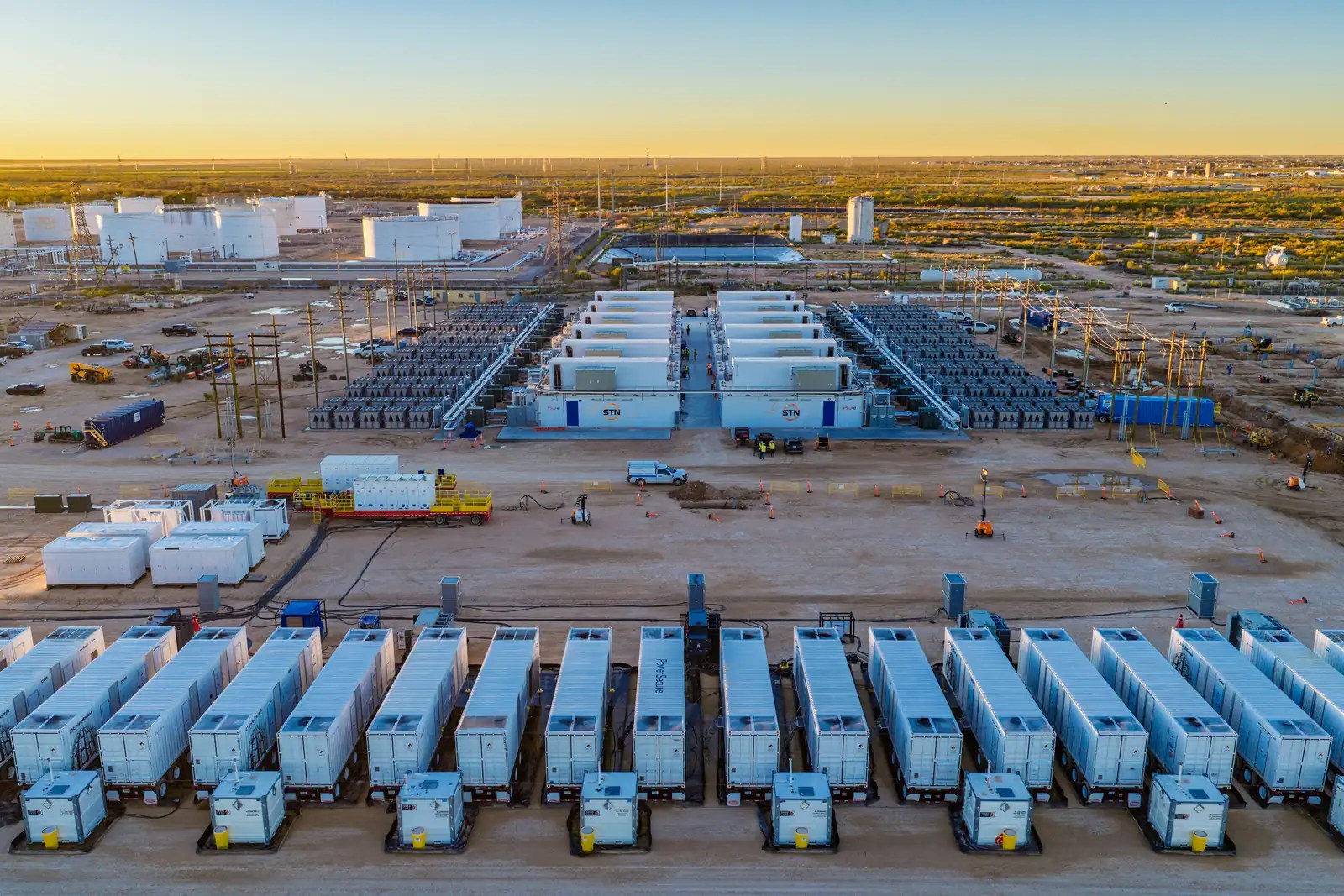
STN describes onsite generation, battery storage and a utility connection. Combining multiple sources may improve delivery flexibility, but reliability depends on equipment ratings, switching arrangements, fuel supply and protection coordination. Battery power in megawatts must be distinguished from stored energy in megawatt-hours: a battery can only sustain a given load for a finite period. Related engineering constraints appear in our report on data-center backup cabinets and grid storage.
Cooling and local infrastructure
The developer describes sealed circulating coolant with no process-water discharge. A closed loop transfers heat from equipment to external heat-rejection systems while recirculating the working fluid. It does not eliminate all facility water consumption, and thermal performance depends on ambient conditions and the heat-rejection design. Local reporting documented community discussion of environmental impacts at the November 12 county meeting.
Scaling from a commissioned module to a multi-hall computing campus introduces requirements for network capacity, storage, redundant distribution and synchronized hardware delivery. As our coverage of the XTX Markets facility in Finland illustrates, moving data and operating compute are separate infrastructure challenges. Odessa’s next verifiable milestones are delivery and acceptance of the ordered first phase, followed by any new customer orders for expansion. The partnership has closed; the planned 350 MW development has not been established as operational.


Leave a Reply