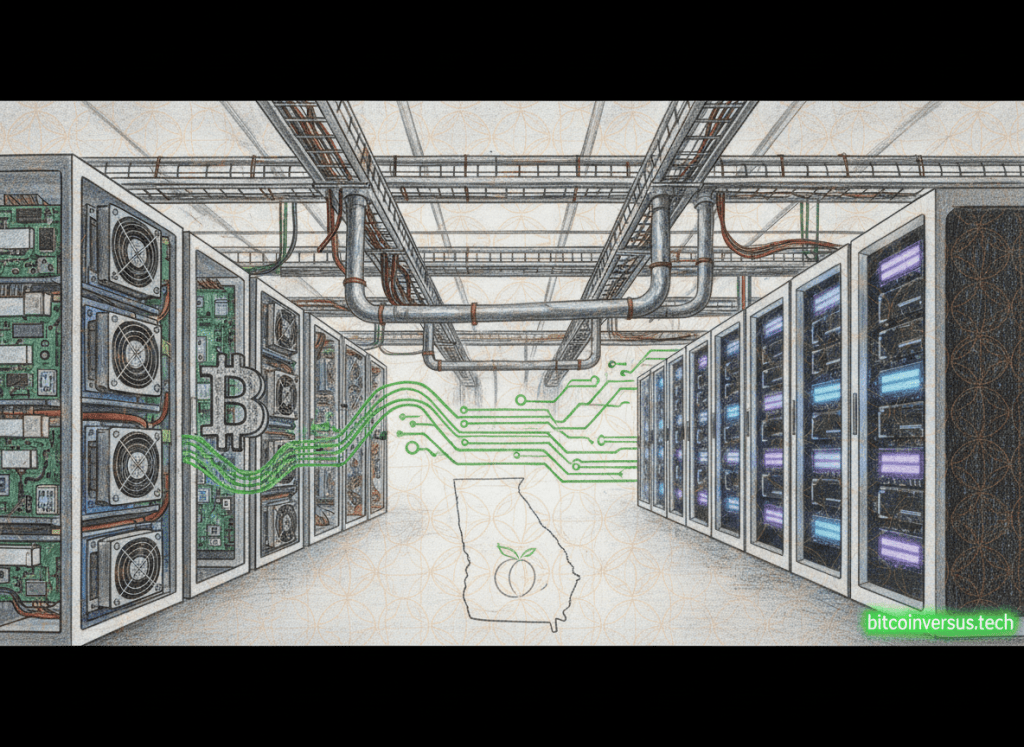
Cango has started commercial GPU compute services inside its 50 MW Bitcoin mining facility in Georgia, turning part of an operating mining site into an AI inference environment while keeping the broader campus tied to its digital-infrastructure strategy.
The September 3 milestone is a concrete example of the mining-to-AI transition moving from plans and financing into operating hardware. Cango’s EcoHash subsidiary says it completed infrastructure modifications for a dedicated AI section supporting up to 3 MW and has put its first batch of GPU servers into commercial service.
A Bitcoin mining site now has a dedicated AI section
The company says the retrofit at its owned Georgia facility includes the electrical, cooling and data-center infrastructure required for GPU compute. The dedicated section currently supports up to 3 MW, with room for future expansion.
The operating update says EcoHash’s first servers are already providing commercial GPU compute services. That is materially different from merely reserving power for a future AI project because revenue-generating compute has begun.
Why miners can move toward GPU infrastructure
Bitcoin mines and AI data centers use different computing hardware, network designs and cooling profiles, but they share one difficult requirement: access to large amounts of dependable electrical capacity. Existing substations, transformers, switchgear, land, fiber and operations teams can give mining operators a head start when adapting a portion of a site for GPU workloads.
BitcoinVersus.tech has been tracking that convergence through miners shifting megawatts from ASICs toward AI, Hut 8’s 1 GW Beacon Point development, Soluna’s mining-to-AI expansion and Bitdeer’s 65.1 MW Malaysia AI expansion.
Cango already operates at Bitcoin-mining scale
Cango entered large-scale Bitcoin mining through major machine and infrastructure acquisitions. BitcoinVersus.tech previously covered Cango’s $352 million shift from auto financing into Bitcoin mining. That installed operating base now provides a platform from which the company can test adjacent forms of high-density compute.
The strategy resembles what the industry is doing elsewhere. Cipher’s Barber Lake AI leases, CleanSpark’s Sandersville AI campus financing and Google’s warrant-linked TeraWulf position show several different financial and technical routes from mining infrastructure toward AI data centers.
EcoHash is starting with inference
EcoHash describes the initial commercial workload as GPU compute for AI inference. Inference runs trained AI models to produce answers, classifications or other outputs. It can have different networking and compute requirements from large-scale model training, potentially allowing operators to enter AI infrastructure incrementally rather than converting an entire mining campus at once.
The broader platform is positioning energy and computing infrastructure as reusable assets. Whether the Georgia deployment expands beyond its initial 3 MW will depend on customer demand, economics and the site’s ability to support additional high-density GPU equipment.
Cango’s mining-to-AI strategy
Cango and EcoHash on X
BitcoinVersus.Tech Editor’s Note:
Support independent Bitcoin, mining, AI hardware and infrastructure reporting: 3C9o19EH5HSiwEPyCTmEKzxhNCbo2X6TTb
BitcoinVersus.tech is not a financial advisor. This media platform reports on financial subjects purely for informational purposes.


Leave a Reply