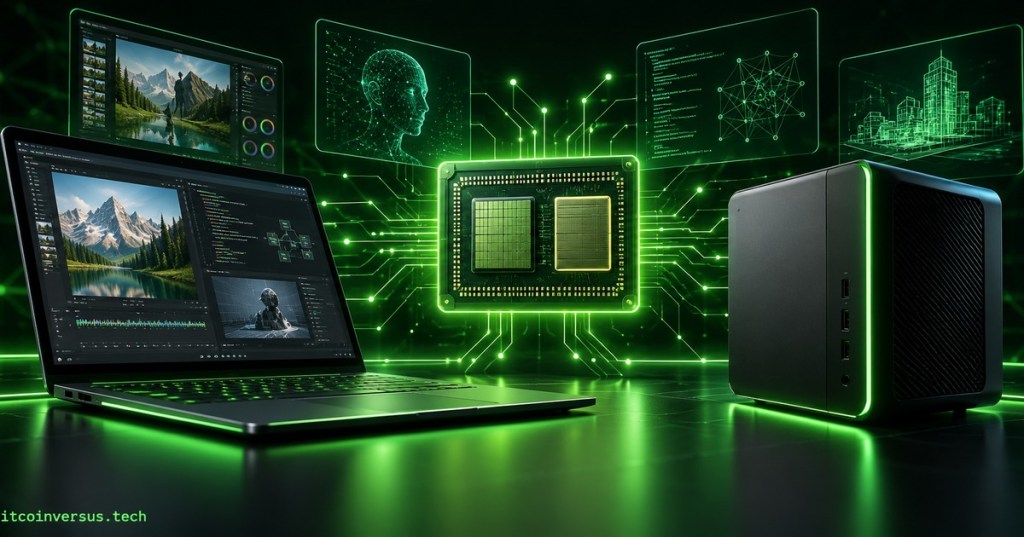
NVIDIA’s RTX Spark is moving from showcase silicon into an October PC launch, putting a Grace CPU, Blackwell-class RTX GPU and large unified-memory pool inside Windows systems designed to run AI agents locally instead of sending every job to the cloud.
NVIDIA’s IFA 2026 update says RTX Spark Windows PCs are arriving in October with systems from Lenovo and Acer among the hardware shown at the event. Reuters reported the October launch as NVIDIA’s latest attempt to shift more AI inference onto personal computers, where latency, privacy and cloud operating costs can look very different from a hosted workflow.
RTX Spark turns the AI PC into a local inference machine
The important part is not simply that another AI-branded laptop chip is entering the market. RTX Spark combines a 20-core Grace CPU with a Blackwell RTX GPU, up to 128GB of unified memory and up to 1 Petaflop of FP4 AI performance. That memory architecture is especially important for local models because the CPU and GPU can work from one large pool instead of forcing developers to think about a small, isolated graphics-memory budget.
That puts RTX Spark in the same broader local-compute race BitcoinVersus.Tech has been tracking with GIGABYTE’s 64GB AI TOP ATOM. The form factors are different, but the direction is the same: more inference, coding assistance, media generation and agent execution is being pushed closer to the user.
NVIDIA’s own RTX Spark account previewed that strategy in its early look at personal AI agents, creator workflows and RTX gaming, showing how the company wants one architecture to cover development, content creation and consumer applications.
NVIDIA PAIR makes multiple PCs act like a small local AI cluster
NVIDIA is also pairing the October hardware push with software meant to make local inference easier to deploy. Its new Personal AI Router, or PAIR, can distribute inference across multiple RTX PCs on the same local network. That turns the household or studio network into a small compute fabric rather than treating every machine as an isolated endpoint.
For developers, that matters because model size and context length can outgrow a single system even when local inference is otherwise attractive. It also fits NVIDIA’s wider effort to make agent software less dependent on one application stack. BitcoinVersus.Tech recently covered how TensorRT Model Connect is being built around coding agents, another sign that NVIDIA increasingly wants to own the runtime layer around the silicon.
The real competition is memory architecture and software compatibility
RTX Spark also pushes NVIDIA into a market where Apple, Qualcomm, AMD and Intel are all trying to define what an AI-first personal computer should look like. Raw TOPS or Petaflops matter, but the harder problem is whether developers can move real models, creative tools and games onto a new architecture without losing too much compatibility.
The unified-memory approach makes the comparison with Apple Silicon especially direct. BitcoinVersus.Tech recently looked at how Apple’s M6 Mac mini is increasing local AI capability on the desktop. RTX Spark answers from the Windows side with CUDA, RTX graphics, a large shared memory pool and a software stack NVIDIA already dominates in professional AI development.
October will test whether local agents are a real PC category
The October launch gives NVIDIA a more concrete test than another developer demo. Lenovo and Acer systems will put RTX Spark in front of buyers who already understand Windows laptops and desktops, while NVIDIA tries to convince them that local agents and local generative workloads justify a new class of hardware.
If the platform works as advertised, RTX Spark could narrow the gap between workstation-class AI development and a personal computer. If software support remains inconsistent, the hardware may still land as a powerful niche for creators and developers. Either way, the semiconductor story is bigger than another chip launch: NVIDIA is trying to move AI infrastructure from the data center all the way onto the desk.
BitcoinVersus.Tech
Advertisement
Editor’s Note
If you value independent technology reporting, consider supporting BitcoinVersus.Tech with a Bitcoin donation: 3C9o19EH5HSiwEPyCTmEKzxhNCbo2X6TTb
BitcoinVersus.tech is not a financial advisor. This media platform reports on financial subjects purely for informational purposes.


Leave a Reply