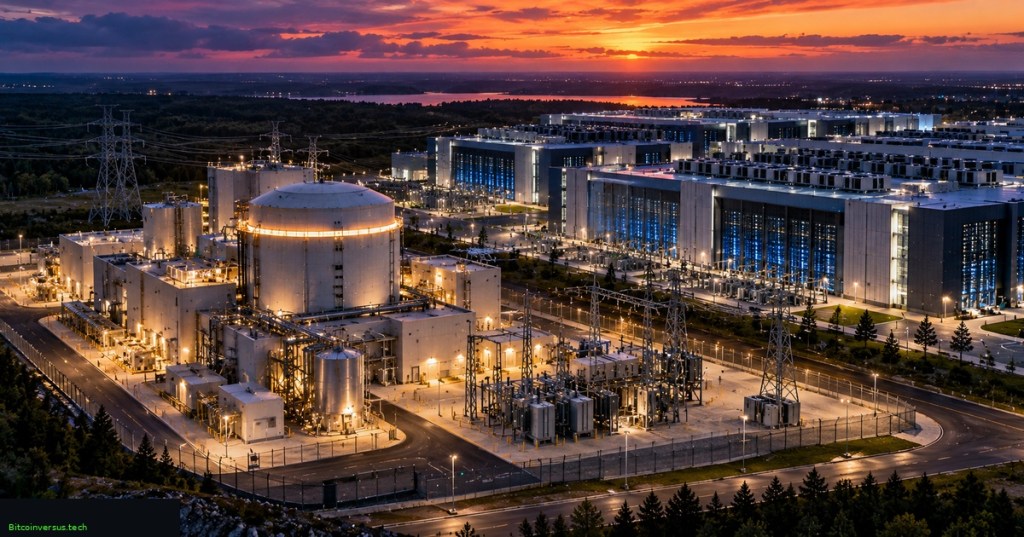
Short answer: yes — but not as a quick plug-and-play fix. Small modular reactors, or SMRs, are technically capable of supplying the steady power a modern data center needs. The problem is not whether a reactor can produce the electricity. The harder questions are how fast it can be licensed, financed, built, fueled, interconnected, and operated at commercial scale.
Why SMRs Fit the Data-Center Problem
Data centers want something solar and wind cannot provide by themselves: large amounts of electricity around the clock. The U.S. Department of Energy notes that current data-center designs can range from about 10 MW to 1 GW, while future facilities could reach several gigawatts. Nuclear generation is attractive because it is designed for long-duration, high-availability operation rather than intermittent output.
That is where capacity factor matters. A 300 MW reactor that runs most of the year can support a continuous computing load very differently from a 300 MW renewable plant whose output moves with weather. Batteries can smooth renewable generation, but they do not create energy; a reactor produces power directly for as long as fuel and maintenance schedules allow.
What Makes an SMR Different From a Traditional Nuclear Plant?
An SMR is smaller than the large gigawatt-scale reactors most people picture when they hear “nuclear plant.” Instead of building one enormous unit, developers can theoretically deploy smaller standardized modules and add capacity in stages. That modularity is the appeal for data centers because a site could potentially match reactor capacity more closely to its actual computing load.
The idea is already being tested commercially. BitcoinVersus has covered Amazon and X-energy’s nuclear data-center plans, along with smaller technologies such as deployable nuclear batteries. These projects all attack the same problem from different scales: how to put dependable generation physically closer to power-hungry computing infrastructure.
Could an SMR Run a Data Center 24/7?
Technically, yes. Nuclear reactors are well suited to baseload operation, and the Department of Energy specifically identifies data centers as a potential use case for next-generation reactors. A sufficiently sized SMR plant could supply the majority or all of a data center’s steady electrical demand, especially if the site also has grid backup, energy storage, or redundant generation.
That does not mean one reactor automatically equals one self-contained data center. Large facilities need redundancy. A campus still has switchgear, UPS systems, generators, PDUs, transformers, A/B feeds, and protection systems between the generator and the server rack. Even a reactor can trip, shut down for maintenance, or lose an electrical path.
The Real Problem Is Deployment Speed
This is where the answer changes from “yes” to “yes, eventually.” The U.S. Nuclear Regulatory Commission is actively processing advanced-reactor and SMR applications, but licensing is only one stage. A project also needs a site, financing, construction crews, reactor components, fuel, security systems, emergency planning, transmission or private-wire infrastructure, and an operating organization.
Data-center demand can move much faster than nuclear construction. A technology company may want hundreds of megawatts within a few years, while a first-of-a-kind reactor project can require a longer development cycle. That timing mismatch is one reason existing nuclear plants, plant restarts, and uprates can sometimes serve AI loads sooner than entirely new reactors. BitcoinVersus has already covered Amazon’s 190 MW Calvert Cliffs nuclear uprate agreement and Google-backed nuclear restart activity in Iowa.
SMRs Could Solve the Land Problem Better Than Renewables
Nuclear energy is extremely energy-dense. A reactor campus can produce large amounts of electricity on far less land than an equivalent nameplate buildout of solar or wind. That matters for data-center operators trying to colocate generation close to expensive fiber routes, substations, water systems, and server campuses.
That land advantage becomes especially important when comparing nuclear with the question BitcoinVersus recently asked in “Can Solar Power Run a Data Center 24/7, or Nah?” Solar absolutely can contribute huge amounts of energy, but reaching round-the-clock operation requires oversizing, storage, transmission, or another firm generation source. An SMR begins with firm generation and adds redundancy around it.
The Hard Part: Cost and First-of-a-Kind Risk
The biggest uncertainty is economics. SMRs are supposed to lower cost through factory fabrication, repeatable designs, smaller project sizes, and staged deployment. But those advantages become real only after enough units are built to create manufacturing repetition and a mature supply chain.
The first few projects therefore carry the hardest burden. They have to pay for engineering, licensing, supply-chain development, specialized construction, and operational learning before later projects can benefit from standardization. That is why an SMR can make technical sense for a data center while still being difficult to finance today.
Could SMRs Help With the Data-Center Power Shortage?
Yes, especially over the longer term. BitcoinVersus previously covered estimates of a 33 GW U.S. data-center power shortfall. If AI campuses continue moving toward gigawatt-scale loads, utilities and technology companies will need more than one solution: grid upgrades, gas generation, renewables, batteries, demand response, existing nuclear output, and new nuclear technologies can all play roles.
SMRs are compelling because they could eventually give operators a scalable block of carbon-free firm power without requiring a traditional multi-gigawatt nuclear station. The technology fits the electrical problem extremely well. The commercial deployment system still has to catch up.
So: Can SMRs Power Data Centers, or Nah?
Yeah — technically, absolutely. A properly sized SMR or group of SMRs can provide the steady, high-density, 24/7 electricity that data centers want.
But “nah” if the question is whether SMRs can instantly solve today’s data-center power crunch. Licensing, construction, supply chains, fuel, project economics, and first-of-a-kind execution remain the bottlenecks. The reactor physics already works. The industrial deployment machine is what still has to scale.
For primary technical context, see the U.S. Department of Energy’s analysis of nuclear-powered data centers and the U.S. Nuclear Regulatory Commission’s 2026 advanced-reactor licensing milestones.
BitcoinVersus.Tech
Advertisement
Editor’s Note
The “Or Nah?” series tests simple-sounding technology and energy claims against the engineering constraints that determine whether they actually work.
We volunteer daily to ensure the credibility of the information on this platform is Verifiably True. If you would like to support to help further secure the integrity of our research initiatives, please donate here: 3C9o19EH5HSiwEPyCTmEKzxhNCbo2X6TTb
BitcoinVersus.tech is not a financial advisor. This media platform reports on financial subjects purely for informational purposes.


Leave a comment