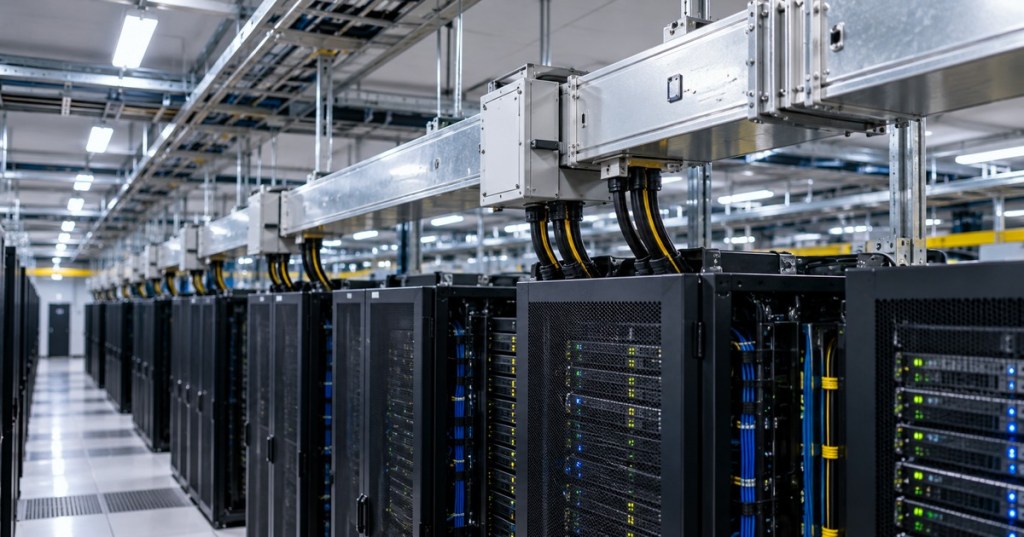
A busway is a rigid electrical distribution system that carries large amounts of power through enclosed conductors, then lets operators tap that power closer to the equipment that needs it. In a modern data center, that often means an overhead rail running above server rows instead of dozens of long branch-circuit cables stretched across the room.
The idea is simple: move high-capacity power along a protected path, then use tap-off boxes to create smaller feeds where racks are installed. The result can be easier to expand, easier to reconfigure, and cleaner to service than a fixed web of cable and conduit.
Busbar and busway are related, but not identical
A busbar is the conductive metal itself, usually copper or aluminum. A busway, sometimes called bus duct, is the complete distribution assembly built around those conductors: enclosure, joints, insulation, tap points, protection, and sometimes metering.
That distinction matters because data-center operators do not install a bare strip of copper above the racks. They install a listed, engineered distribution system designed to carry current safely while providing controlled connection points for downstream loads. Eaton describes track-style busway as a continuous overhead distribution system with flexible tap-off placement and branch-circuit monitoring options.
How the power path works
Power usually reaches the data hall through upstream equipment such as switchgear, transformers, UPS systems, and distribution panels. Our data-center electrical power-path guide explains that full chain. Busway sits farther downstream and carries power over or alongside rows of equipment.
A tap-off box connects to the busway at an approved point and contains the protective and switching hardware needed to feed a rack, rack PDU, or other branch load. Because the tap point can often be placed where the load actually sits, operators can add or relocate rack feeds without rebuilding the entire upstream distribution route.
Why put it overhead?
Overhead busway preserves floor space and keeps a major part of the electrical distribution system visible and accessible. That can simplify changes in facilities where rack density, equipment type, and power demand evolve over time.
It also separates power routing from some of the airflow and floor-management problems found in older raised-floor designs. In high-density rooms, the ability to route power above the racks can make the physical layout easier to understand while leaving more room for cooling, network cabling, and service access.
Why busway is useful in fast-changing data centers
Traditional cable-and-conduit systems work well, but they are often built around fixed branch circuits. Busway changes the problem by creating a reusable electrical backbone. New loads can be connected through compatible tap-off hardware instead of requiring a completely new cable route from the distribution panel every time.
That flexibility becomes more valuable as rack power rises. A facility that changes from lower-density servers to GPU-heavy racks may need to rethink where capacity is available and how quickly new feeds can be deployed. Our capacity-planning guide covers why growth headroom and rack density have to be considered before those changes happen.
Tap-off boxes are the key modular piece
The tap-off box is where the overhead backbone becomes a usable branch circuit. Depending on the system, it can include breakers, disconnects, metering, communication hardware, and connectors sized for the downstream load.
Schneider Electric’s iBusway documentation shows data-center configurations built around feeder units, tap-off units, metering, communications, and both overhead and raised-floor installations. The exact arrangement varies by manufacturer and facility design, but the basic architecture is consistent: a main power path plus modular connection points.
Busway does not replace protection or good design
A busway is still part of an electrical system that must be properly engineered for voltage, current, fault duty, grounding, coordination, maintenance, and local code requirements. The fact that a system is modular does not make it plug-and-play in the casual sense.
Upstream switchgear, breakers, panelboards, and PDUs still determine how faults are isolated and how power is divided. For a broader look at those components, see our guide to switchgear, switchboards, panelboards, and PDUs.
The easy way to picture it
Think of busway like an electrical highway above the racks. The busway is the main road, the conductive busbars carry the traffic, and tap-off boxes are the exits that send power to individual destinations.
That is why busway has become such a natural fit for modern data centers: the building can keep a strong central power backbone while changing the last few feet of distribution as racks, servers, and compute density evolve.
BitcoinVersus.Tech
Advertisement
Editor’s Note
We volunteer daily to help keep the information on this platform verifiably accurate. If you would like to support our independent research, please donate here: 3C9o19EH5HSiwEPyCTmEKzxhNCbo2X6TTb
BitcoinVersus.tech is not a financial advisor. Content is provided for informational purposes.


Leave a Reply