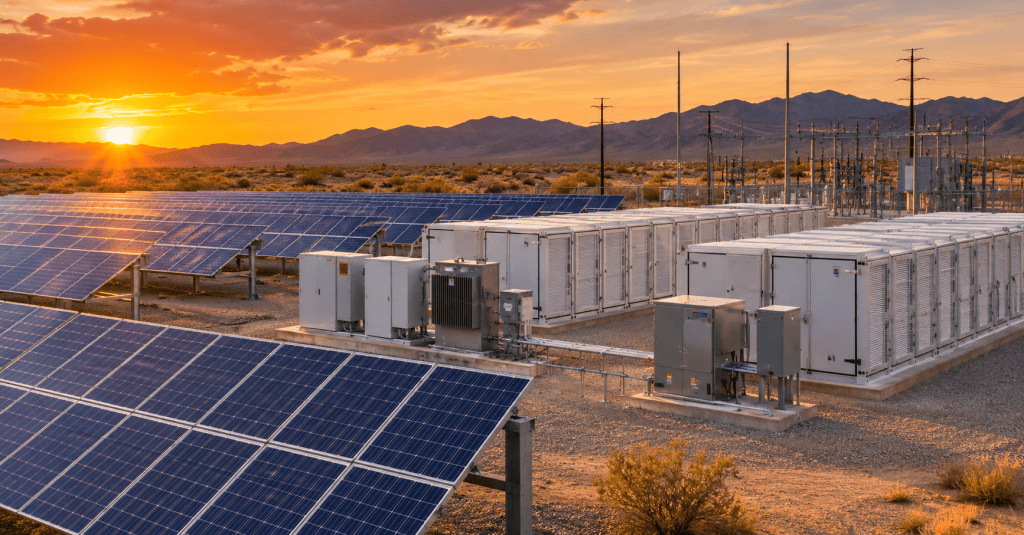
American solar developers are increasingly building battery storage alongside photovoltaic power plants, giving operators greater control over when electricity reaches the grid. More than 16% of utility-scale solar capacity added during the first nine months of 2026 was paired with operational batteries, compared with 2% in 2017, according to an October 30 analysis by the U.S. Energy Information Administration (EIA).
The figures come from EIA-860M, a monthly generator inventory based on information reported by plant operators. The trend reflects a growing business case for storing solar electricity during low-price hours and delivering it when wholesale prices rise. It does not mean batteries accompany 16% of all solar plants ever built.
Source chart: EIA’s annual solar capacity additions and co-located battery storage analysis, published October 30, 2026.
Solar power becomes more flexible
Conventional solar installations produce electricity when sunlight is available. Their output often peaks during hours when many neighboring solar plants are generating simultaneously, pushing regional wholesale prices downward. Batteries allow operators to move some of that output into later periods, potentially improving revenue and helping balance evening demand.
Co-location can also simplify some aspects of project development by sharing land, electrical equipment and interconnection infrastructure. However, battery charging, discharging and conversion all involve energy losses, while fire protection, maintenance, financing and battery replacement add costs. Whether a paired installation outperforms separate assets depends on local market prices, operating rules and engineering design.
The EIA estimates that co-located storage could account for 19% of utility-scale solar additions across full-year 2026 if the remaining reported projects enter service as planned. Developers’ longer-range schedules indicate a share exceeding 30% in 2027 and 2028. Those later figures describe proposed projects, not completed generating capacity, and may change as construction schedules shift.
Data and methodology: EIA-860M monthly generator inventory. Project plans are distinguished from commissioned assets.
Southwestern states lead
As of September 2026, solar photovoltaic plants represented 13% of total U.S. utility-scale generating capacity. EIA reported that 18% of existing utility-scale solar capacity was co-located with batteries. The co-located share in California, Arizona, New Mexico and Nevada was more than twice the national average, reflecting the region’s substantial solar buildout and the economic value of shifting output across the day.
Generating capacity is measured in megawatts (MW), while the energy stored by a battery is measured in megawatt-hours (MWh). A 100 MW battery with 400 MWh of usable stored energy could theoretically discharge at full rated power for four hours before accounting for operating restrictions and losses. Neither figure alone establishes how much electricity a hybrid plant actually delivers annually.
Growing solar-plus-storage deployment can help grid operators handle variable renewable generation, but batteries do not eliminate extended cloudy-weather risks, transmission congestion or the need for other firm and flexible resources. The next meaningful measure will be how reliably new installations perform during peak-demand hours, rather than how much capacity developers announce.
Editor’s Note: Figures reflect EIA’s October 30, 2026 report and operator submissions through September. Planned additions are subject to revision.


Leave a Reply