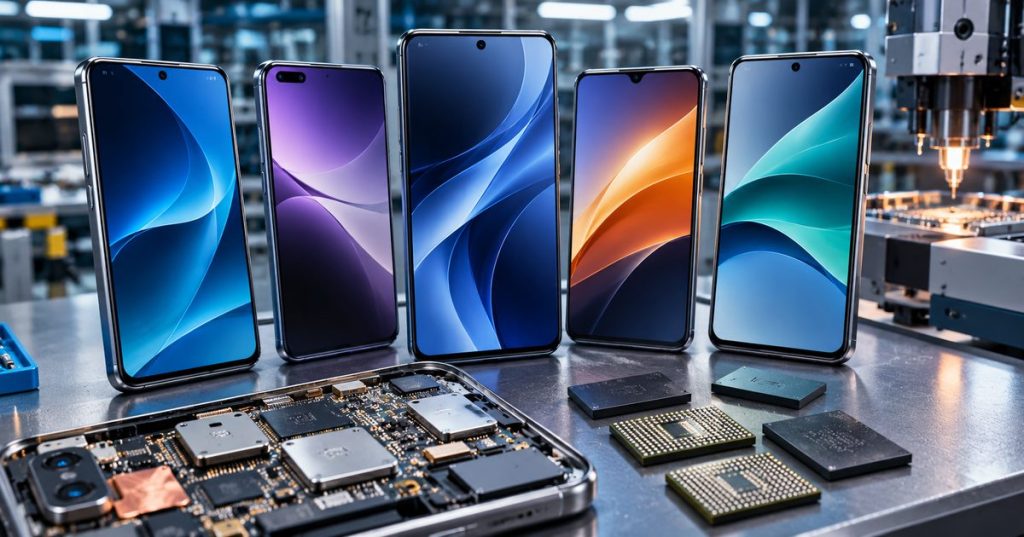
Worldwide smartphone shipments dropped 22.0% in the third quarter of 2026, falling to 255.3 million units from 327.3 million a year earlier. The 72-million-unit contraction was the largest year-over-year quarterly decline recorded by market researcher IDC, according to its October 15 release. The figures are preliminary estimates of newly shipped branded handsets, not a count of phones purchased by consumers.
Modern smartphones rely on DRAM for temporary working memory and NAND flash for persistent storage. IDC attributed much of the industry’s squeeze to sharply higher memory costs, citing an approximately 350% annual increase in its cost estimates. Component inflation can compress manufacturers’ margins, force higher retail prices and make inexpensive devices harder to produce profitably.
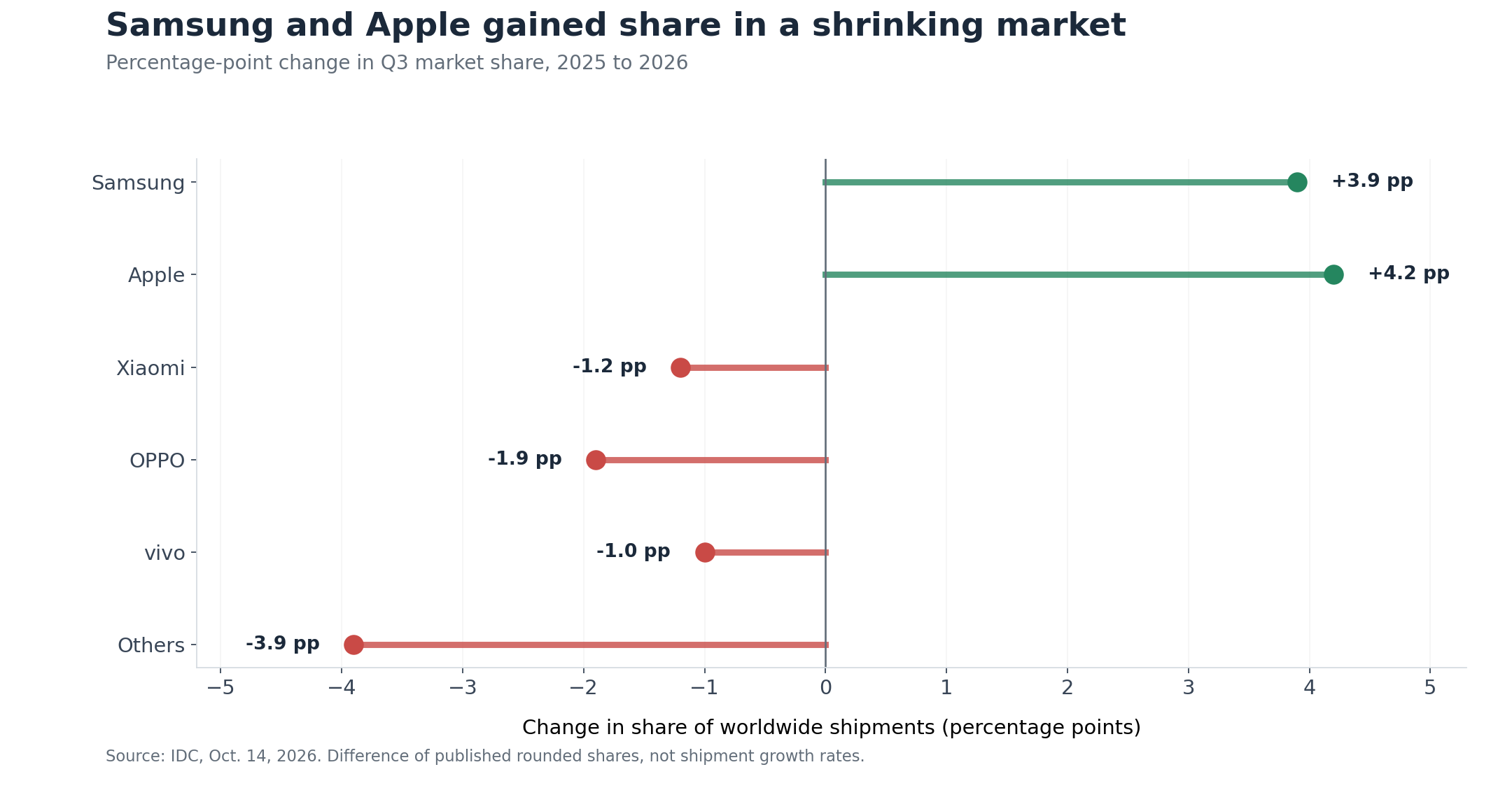
Apple and Samsung gain market share without gaining sales volume
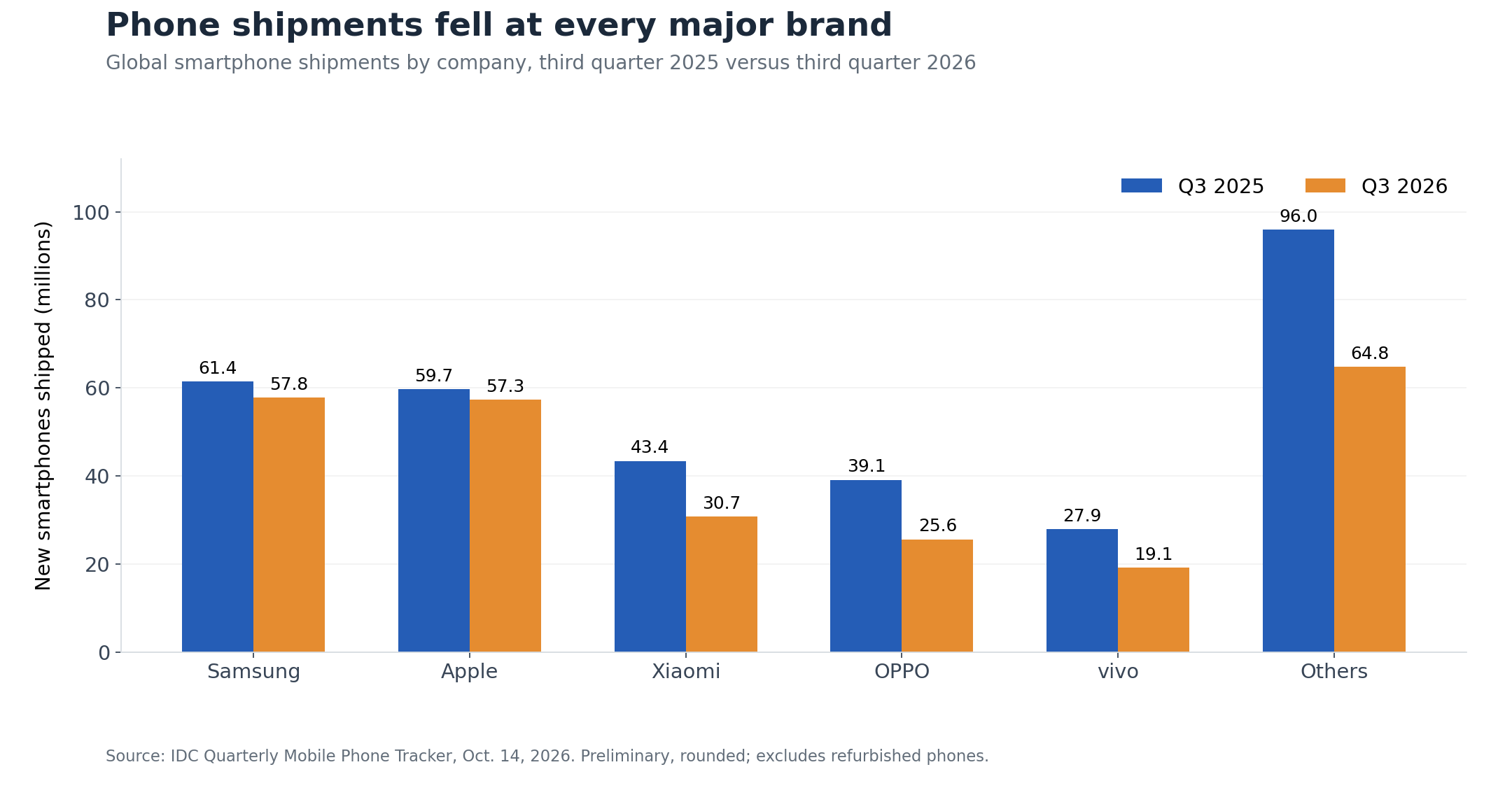
Samsung led with 57.8 million shipments, down 5.8% from 61.4 million. Apple followed at 57.3 million, down 4.0% from 59.7 million. Their combined third-quarter market share rose to 45.0%, against 36.9% a year earlier. Apple’s share increased by 4.2 percentage points and Samsung’s by 3.9 points. Neither company recorded positive unit growth in IDC’s quarterly comparison.
The divergence was larger at Xiaomi, whose shipments fell 29.2% to 30.7 million; OPPO fell 34.5% to 25.6 million; and vivo dropped 31.5% to 19.1 million. IDC said manufacturers with greater exposure to budget smartphones face particularly difficult pricing trade-offs. Recent coverage of Apple’s folding iPhone illustrates the premium-device strategy, but one product’s launch does not explain the entire market shift.
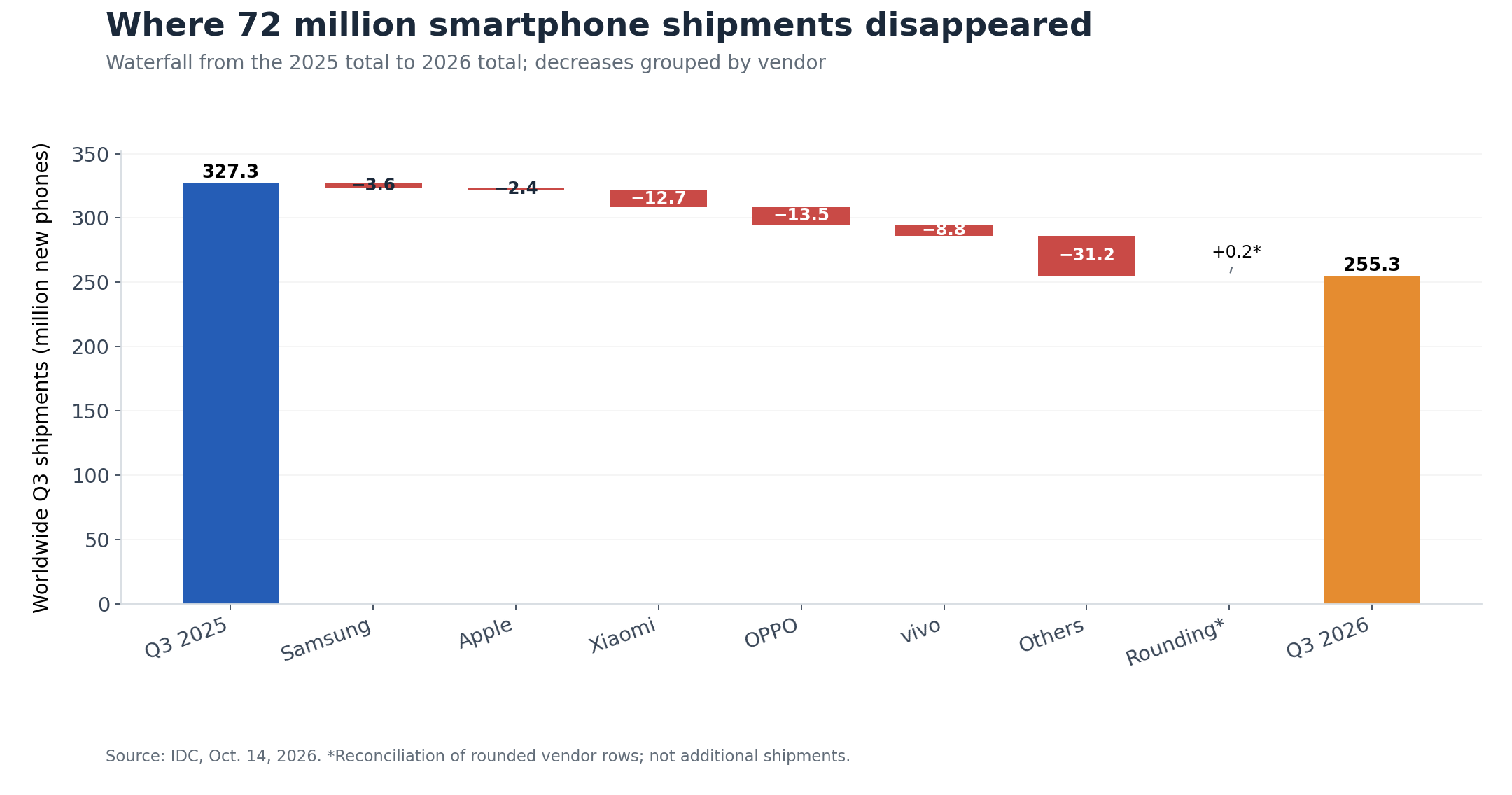
Where 72 million shipments disappeared
IDC’s worldwide quarterly totals imply 72.0 million fewer new devices shipped. Xiaomi, OPPO and vivo collectively accounted for 35.0 million fewer shipments, while the group of all other brands declined by 31.2 million. Samsung and Apple together declined by 6.0 million. The component figures are based on rounded vendor rows and therefore require a small reconciliation adjustment.
A shipment is a unit supplied into a distribution channel, not necessarily a completed retail sale. Lower shipments can reflect weaker customer demand, reduced factory output, inventory management or several forces together. IDC’s earlier final second-quarter figures recorded a 7.4% annual decline, making the third-quarter deterioration especially severe. BitcoinVersus.Tech also reported a 20.1% contraction in PC shipments. The two market totals are separate device categories.
Memory shortages complicate the recovery
The pressure reaches beyond smartphone assemblers. Silicon wafer shipments can grow even while consumer-device units contract, because semiconductor demand spans AI servers, power chips, networking and industrial applications. Likewise, higher chip-industry sales revenue cannot be converted directly into a higher number of phones sold. For technical background, NAND and NOR flash serve different storage functions; neither should be confused with DRAM.
IDC expects industry growth to remain constrained through 2027, with a possible recovery no earlier than 2028. That timing is a forecast, not an observed outcome. Elevated costs, delayed upgrades and excess inventory pose risks, while well-capitalized manufacturers may protect margins through premium products and supply agreements. Preliminary vendor estimates can also change after IDC’s final historical tracker is released.
Sources: IDC Worldwide Quarterly Mobile Phone Tracker, October 15, 2026; IDC final Q2 2026 smartphone results.
Editor’s Note: Shipments, changes and market shares were checked against IDC’s October 2026 preliminary Worldwide Quarterly Mobile Phone Tracker. Branded new-device shipments exclude refurbished phones and unbranded OEM sales. IDC’s published rounded Q3 2025 vendor rows sum to 327.5 million, whereas the published global total is 327.3 million; the waterfall explicitly reconciles the 0.2-million difference. The story’s featured image is an original AI-generated editorial illustration, not a photograph of an actual manufacturer or production facility. IDC’s research microdata were not independently audited.
Support BitcoinVersus.Tech
To donate 5,000 satoshis, scan the original BitcoinVersus.Tech donation QR below with a compatible Bitcoin wallet. Mobile readers can display the article on another screen and scan it, or use a wallet’s supported QR image-import function. Verify the destination and payment amount before sending.

We volunteer daily to ensure the information on this platform is Verifiably True. If you would like to support the research, please scan QR code.


Leave a Reply