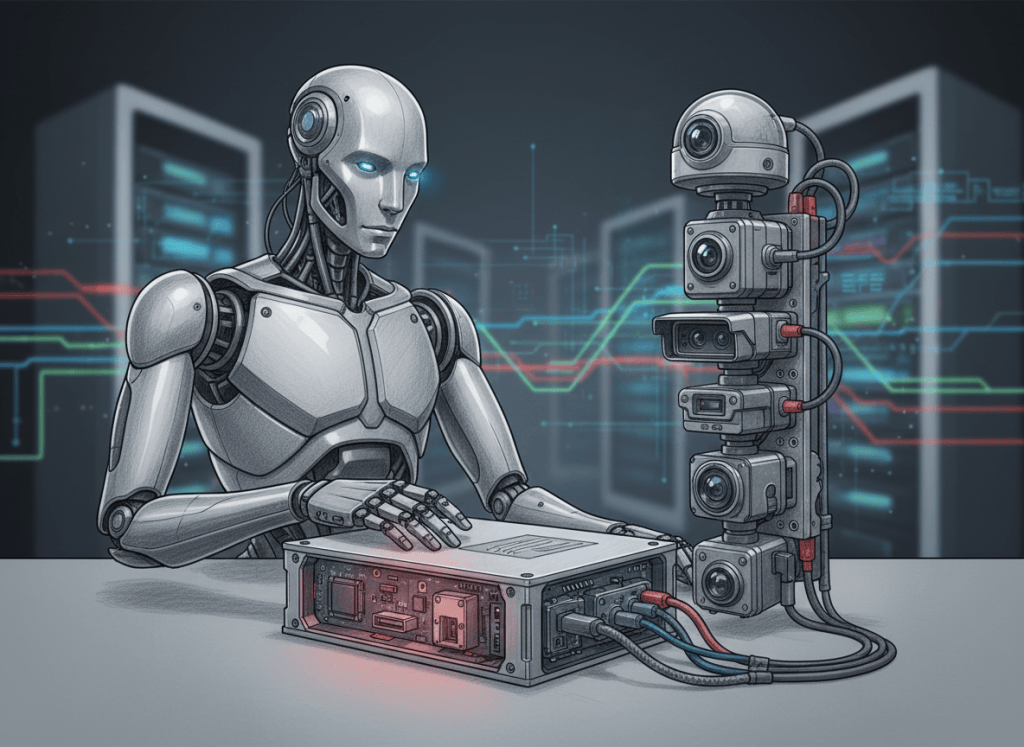
AMD used ROSCon 2026 in Toronto to make a broader case for physical AI: intelligent systems need more than a powerful accelerator. They need a balanced mix of CPUs, GPUs, NPUs, adaptive compute, sensors, real-time control and open software that can work together from cloud training to deployment on an actual robot.
The company’s ROSCon program, held Sept. 22–24, included humanoid robotics, semantic navigation, simulation, autonomous manipulation and open robotics development. AMD said its goal was to show developers how heterogeneous compute and open software can help train, simulate and deploy intelligent robotic systems from the cloud to the edge.
AMD is pushing physical AI beyond the demo stage
At the event, AMD highlighted a Foundation Robotics Phantom MKI humanoid running a full-body control stack on an AMD Ryzen AI Embedded processor. The company also showed an open simulation environment with Robotec.ai, an AMD Kria AI Robotics Developer Platform demo, semantic navigation using a text-prompted foundation model with Nav2, and a mobile manipulator that moved from simulation into a real-world fetch task.
That systems-level approach matters because robotics workloads are unusually mixed. Perception, language, planning, motor control and safety all have different latency and compute requirements. A robot that looks impressive in a staged demonstration still has to coordinate those tasks predictably under real limits for power, thermals, memory and cost.
AMD’s robotics push also builds on earlier embedded-platform partnerships. A related social post highlighting an AMD and BlackBerry advanced robotics platform provides additional context for the company’s longer-running effort to place heterogeneous compute and open software inside autonomous machines.
From cloud training to the robot
AMD also hosted a workshop titled “Train, Simulate, Deploy: Agentic AI from Cloud to Robot.” The session focused on end-to-end workflows that begin with cloud training and simulation and end with models running on physical hardware. That mirrors a larger shift in AI infrastructure: the same industry that has spent years optimizing giant data-center clusters is now trying to carry more intelligence into embedded systems at the edge.
BitcoinVersus.tech has previously examined how AMD is competing with NVIDIA at the rack scale and how model routing can move AI workloads between cloud and edge systems. Physical AI brings those same resource-allocation questions into machines that must perceive and act in the real world.
AMD’s own physical-AI overview also frames robotics as a heterogeneous-compute problem spanning autonomous robots, intelligent vehicles, industrial automation and healthcare.
Why the hardware stack matters
For robotics developers, the important takeaway is that physical AI is becoming a full-stack hardware problem. A single robot may need high-performance CPU cores for general orchestration, GPU compute for vision and simulation, an NPU for local inference, adaptive logic for deterministic I/O, and tightly integrated software to keep all of those components synchronized.
AMD’s strategy is to make that stack more open and heterogeneous rather than forcing every workload through one processor type. Whether that approach wins broad adoption will depend on developer tooling, reliability, power efficiency, partner support and how easily teams can move from simulation to production hardware.
The company’s ROSCon announcement makes clear that AMD now sees robotics and physical AI as a major extension of its broader AI computing business rather than a side market. The next phase will be measured less by conference demos and more by how many of these systems reach factories, warehouses, vehicles and other real operating environments.
BitcoinVersus.Tech Editor’s Note:
BitcoinVersus.tech is not a financial advisor. This media platform reports on financial subjects purely for informational purposes.


Leave a Reply