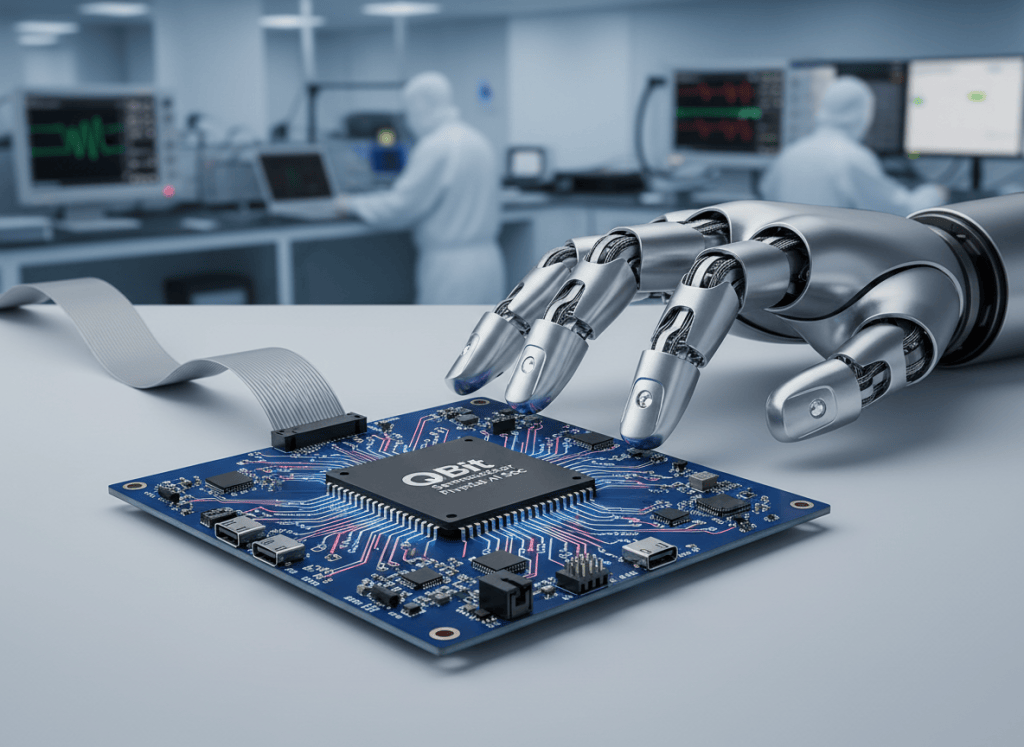
QBit Semiconductor is pushing deeper into physical AI with a new system-on-chip roadmap designed to put high-level AI processing and fast motor control inside the same silicon platform.
At SEMICON Taiwan 2026, the company introduced its QB88XX series for dexterous robotic hands and industrial automation. QBit says the chip can coordinate up to 32 motors while combining general application processing, neural-network acceleration and a separate real-time servo-control path. That architecture is why QBit describes the design as a robotic “cerebellum.”
The idea fits a broader physical-AI shift that has been taking shape across the robotics industry: large AI models may decide what a machine should do, but real robots still need deterministic electronics to turn those decisions into safe, precisely timed physical movement.
One SoC, Two Different Control Jobs
According to QBit’s own technology profile, the company has long focused on image processing and precision motion control. QB88XX brings those specialties into robotics. The announced architecture combines four Arm Cortex-A78 CPU cores and an NPU for higher-level commands with an Arm Cortex-M7, QBit’s TGEN engine and a second NPU dedicated to motor-servo control.
That division matters. A robot arm or hand cannot wait unpredictably for a large operating system or AI workload before correcting a joint position. Servo loops must respond on strict timing. QBit’s design attempts to keep that low-level control close to the motors while still giving the same SoC enough compute for perception and AI-assisted behavior.
BitcoinVersus.tech has been tracking the same convergence from several directions. Qualcomm’s PickNik deal adds MoveIt robotics software to its edge-AI push, while NVIDIA Isaac ROS 5.0 is bringing AI agents closer to real robot workflows. On the silicon side, EdgeCortix is targeting physical AI with dedicated accelerator hardware.
Designed for Hands With More Than 20 Degrees of Freedom
QBit is specifically positioning QB88XX for dexterous robotic hands with more than 20 degrees of freedom. The company says one chip can support as many as 32 motors and includes AI servo tuning plus PCIe, USB, CAN Bus and camera interfaces. An independent electronics-industry report describes the same architecture and its emphasis on consolidating multi-joint control.
That is a useful comparison point with the increasingly sophisticated humanoid hands already appearing in robotics. More joints mean more motor channels, feedback signals and timing-sensitive control loops. Shrinking those functions onto fewer chips can potentially reduce board area, wiring complexity and power consumption, although QBit has not published independent benchmark data demonstrating those system-level gains.
The Same Architecture Is Headed Toward Drones
QBit also outlined a two-stage drone plan. From 2026 through 2028, its QB77XX platform is intended to combine mission-computer workloads with real-time flight control using Cortex-M33 and TGEN resources. From 2029 onward, the company plans a drone-specific QB88XX that further combines flight control, mission computing, optical-flow control and target tracking.
The company says a QB77XX demonstration maintained single-object tracking through visual occlusion at relative speeds up to 60 km/h, with multi-object tracking planned for the fourth quarter of 2026. Those figures are company-reported demonstration claims, not independent BitcoinVersus.tech test results.
The roadmap also shows why specialized silicon remains important even as general-purpose AI accelerators become more powerful. BitcoinVersus.tech recently covered Dnotitia’s dedicated vector-search ASIC reaching first silicon and Alibaba’s Zhenwu V900 AI processor. QB88XX targets a different workload: not giant data-center inference, but AI plus tightly timed electromechanical control at the edge.
What Still Needs to Be Proven
QBit’s architecture is technically interesting, but the announcement is a roadmap, not proof that QB88XX has already won large-volume humanoid or drone deployments. Key unanswered questions include process node, production timing, measured power consumption, deterministic control latency, software support and how the platform performs against multi-chip alternatives under real robot workloads.
Still, the direction is clear. As physical AI moves from demos toward machines that must operate continuously, robot designers increasingly need silicon that treats perception, inference, communications and motor control as one system rather than unrelated components. QB88XX is QBit’s bet that the “robot brain” will need a dedicated electronic cerebellum beside it.
BitcoinVersus.Tech Editor’s Note: We volunteer daily to help ensure the credibility of information on this platform is verifiably true. Product specifications, roadmap dates and demonstration performance attributed to QBit Semiconductor are company-reported unless otherwise stated. BitcoinVersus.tech is not a financial advisor. This article is independent technology reporting for informational purposes only.
Follow BitcoinVersus.Tech through our continuing technology coverage.


Leave a Reply