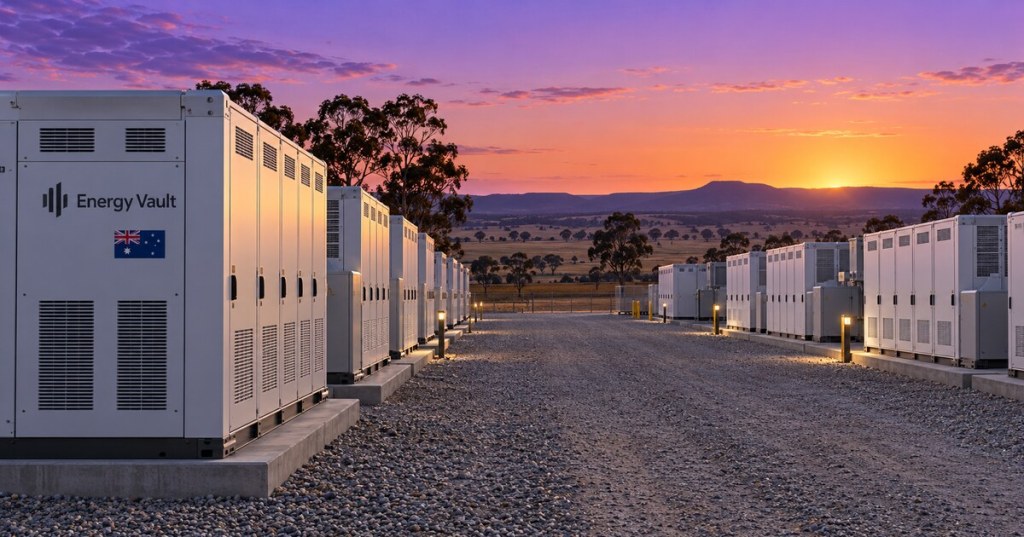
AI-generated conceptual illustration of battery storage in Australia; not a photograph or approved rendering of Stoney Creek.
Energy Vault’s Stoney Creek battery project has secured New South Wales planning approval, bringing a proposed 125 MW / 1 GWh storage installation in Narrabri closer to construction. The company announced the milestone on September 29, 2026.
The public register records the approval date as September 22 under application SSD-75680468. The distinction matters: September 29 is the announcement date, while the planning decision came a week earlier.
Eight hours in two numbers
The project’s registered capacity separates power from stored energy: 125 MW describes the discharge rate, and 1,000 MWh describes the energy capacity. Dividing 1,000 MWh by 125 MW gives eight hours. That is the nominal duration represented by the ratings, rather than a measurement from an operating plant.
Duration adds a useful comparison to our coverage of large battery installations and solar and battery project delivery. Readers comparing projects should look at both MW and MWh; the power figure alone does not reveal how long a battery can discharge.
The delivery schedule remains ahead
According to the announcement, geotechnical work finished in late August. Site works and mobilization are expected in the fourth quarter of 2026, with commercial operation targeted for the first half of 2028, subject to remaining conditions and project requirements.
Energy Vault says a 14-year Long-Term Energy Service Agreement supports the project. Together with anticipated merchant revenues, management expects annual project revenue of US$25 million to US$30 million once operational. That is a forecast of revenue, not profit or cash already earned.
From consent to usable grid capacity
Energy Vault plans to use its VaultOS platform for performance and market participation, and its stated goal is to support grid reliability and renewable integration. The next milestones to watch are the start of site works and eventual commissioning.
For context, our recent reporting covers solar development portfolios and wind certification in Australia. Those are separate projects, but together they offer a way to follow generation, storage and the steps between a development announcement and operating infrastructure.
BitcoinVersus community promotion
For readers who also follow our mining coverage, the published offer below is a separate BitcoinVersus promotion. It is separate from the battery project reported above.
BitcoinVersus.Tech Editor’s Note:
We volunteer daily to ensure the credibility of the information on this platform is Verifiably True. If you would like to support our research initiatives, you can donate here: 3C9o19EH5HSiwEPyCTmEKzxhNCbo2X6TTb
BitcoinVersus.tech is not a financial advisor. This media platform reports on financial subjects purely for informational purposes.


Leave a Reply