
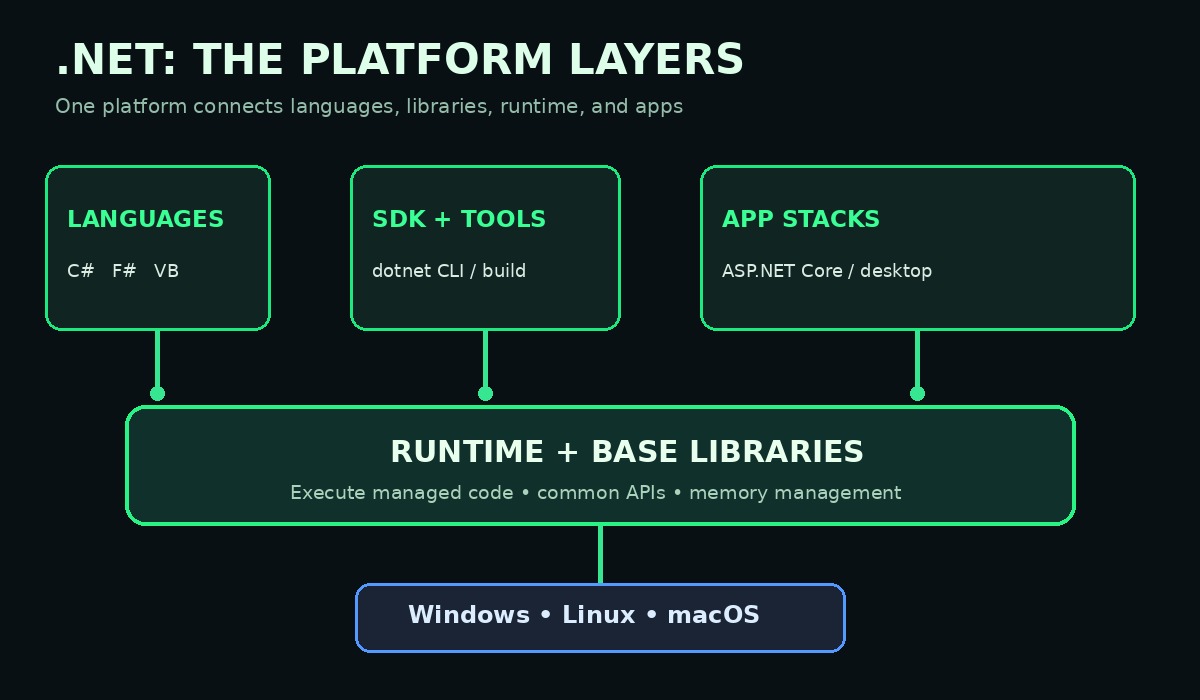
.NET is a free, open-source software development platform, not a programming language. It combines languages, a runtime, reusable libraries and developer tools. Think of it as a workshop: the language describes what to make, the SDK builds it, and the runtime runs it.
Four Parts of .NET
Languages such as C#, F# and Visual Basic describe instructions. The software development kit (SDK) provides compilers and tools. Libraries provide reusable features such as files, networking and collections. The runtime executes managed code and provides services including memory management. These parts work together, but are not interchangeable. Read the official .NET introduction.
Runtime Versus SDK
A runtime-only installation can execute compatible existing applications. To create, compile, test and publish new projects, developers generally install the .NET SDK. The SDK includes runtime components. The distinction is like having a music player versus the tools for recording music.
What Can You Build?
Modern .NET supports command-line tools, desktop applications, websites, background services and web APIs. ASP.NET Core is a framework for web applications and services. .NET runs on Windows, Linux and macOS, although specific application frameworks have their own operating-system requirements. C# is a language commonly used with .NET, not another name for the platform. See the history of programming languages.
Inspect an Installation
Open a terminal and run these commands. The first displays environment information, the second installed SDKs, and the third installed runtimes. If the command is missing, verify installation and the executable’s PATH setting.
dotnet --info
dotnet --list-sdks
dotnet --list-runtimesBuild a First Console Program
Install a supported SDK from the official download page. The following commands create a folder, generate a console application and run it. This is a demonstration of the toolchain; later lessons cover C# syntax and project files.
mkdir DotNetHello
cd DotNetHello
dotnet new console
dotnet run
Exercises
1. Explain why .NET is a platform rather than a language. 2. Describe the different jobs of the SDK, runtime and libraries. 3. Compare the outputs of dotnet --list-sdks and dotnet --list-runtimes. 4. If the SDK is installed, create and run a console project. 5. Explain why a runtime-only installation cannot normally run dotnet new console.
Knowledge Check and Answers
Q1: Is .NET itself a programming language? No, it is a platform. Q2: What executes managed code? The runtime. Q3: What builds new projects? The SDK. Q4: What provides reusable file and networking features? Libraries. Q5: Which command lists installed SDKs? dotnet --list-sdks.
Next Lesson
Remember: languages express instructions, SDK tools build programs, libraries supply reusable features, and the runtime executes managed code. Next in this track: OSDotNet.002 — What the Common Language Runtime Does. Sources: Microsoft Learn .NET introduction and SDK overview.


Leave a Reply