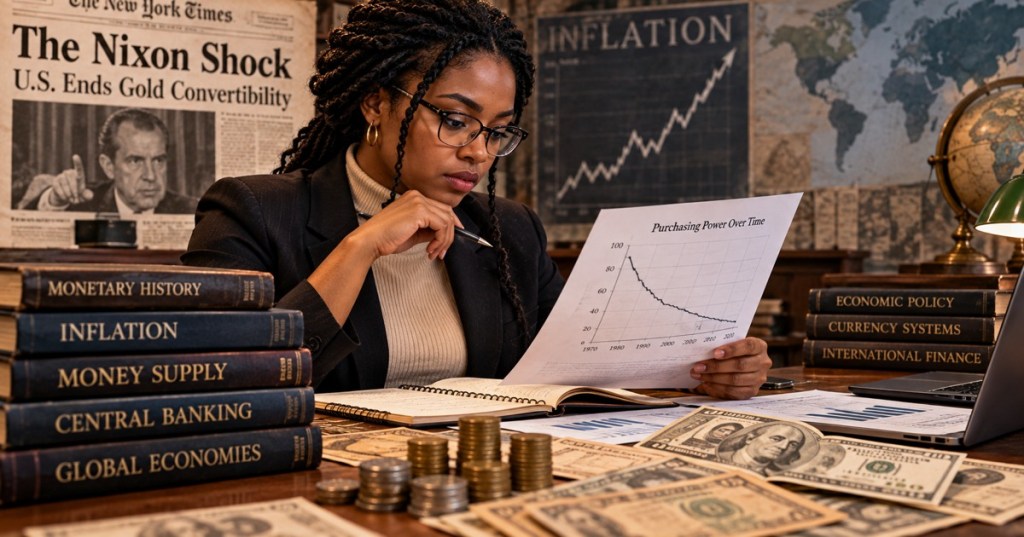
Inflation describes a sustained increase in the general price level. Its practical consequence is that a unit of money buys fewer goods and services than before. This lesson examines the historical development of inflation measurement, monetary expansion, the relationship between money and production, and the difference between nominal and real purchasing power.
OSHistory.009 follows OSHistory.008: The Nixon Shock and the End of Dollar-Gold Convertibility. Ending dollar-gold convertibility in 1971 was a major change in the international monetary system, but inflation existed before 1971 and cannot be attributed to that event alone.
Learning objectives
- Distinguish inflation, disinflation, deflation, and relative-price changes.
- Explain consumer price indexes and purchasing-power calculations.
- Distinguish nominal wages from real wages.
- Describe monetary expansion, demand shocks, supply shocks, and inflation expectations.
- Apply historical context without treating correlation as causation.
What inflation measures
A rise in the price of one commodity is not necessarily general inflation. A poor harvest may increase the price of wheat while other prices remain stable. Economists generally use price indexes to summarize changes across a broad basket of consumer purchases. In the United States, the Bureau of Labor Statistics publishes the Consumer Price Index (CPI). The Bureau of Economic Analysis publishes the Personal Consumption Expenditures (PCE) price index.
Khan Academy explains inflation, prices, and the CPI measurement approach.
Purchasing power and index arithmetic
Suppose a representative basket costs $100 in the base period and $125 later. Its price index rose 25%. A fixed $100 now purchases 100/125 = 80% of the former basket. The purchasing power of the same nominal money therefore fell 20%, not 25%. In general, purchasing power is inversely proportional to the price level.
The inflation rate between two periods is (new price index / old price index − 1) × 100%. When comparing values across years, use the same index definition and account for methodological revisions.
Nominal versus real income
A worker’s salary rises from $50,000 to $53,000, or 6%. If the consumer price index rises 4% over the same period, the approximate real wage gain is 2%; the exact calculation is 1.06/1.04 − 1 = 1.923%. A higher nominal salary does not automatically mean higher purchasing power.
Money supply and inflation
Economists study the relationship between money supply, spending, real output, and prices. The identity MV = PY represents money (M), its velocity (V), the price level (P), and real output (Y). The identity is always true under consistent definitions but does not alone establish which variable caused another to change. A rapid monetary expansion can contribute to inflation, especially when nominal demand outpaces real productive capacity; the outcome also depends on velocity, credit conditions, expectations, and supply.
Modern broad money includes bank deposits created through lending, not simply paper currency issued by a central bank. Reserve balances, bank credit, and household spending are distinct concepts. Money aggregates can grow without consumer prices rising proportionately over the same interval.
A public economics discussion considers demand, supply, money creation, and the limits of single-cause explanations.
Demand-pull and supply-shock inflation
When aggregate demand increases faster than the economy can produce goods and services, prices may rise. Inflation can also accelerate after supply disruptions such as energy shortages, transport bottlenecks, crop failures, or wars. These mechanisms can interact: a temporary shock may persist if wage-setting, expectations, and policy responses amplify it.
Historical context
Governments and societies have experienced price changes under metal coinage, paper money, convertible banknotes, gold standards, and fiat systems. Debasement could alter a coin’s metallic content, but price outcomes depended on broader institutional and economic conditions. Twentieth-century inflation episodes reflect combinations of war financing, fiscal pressures, monetary accommodation, commodity shocks, and institutional credibility.
The 1970s provide an important example: the United States experienced substantial inflation during a period involving oil shocks, wage-price dynamics, policy choices, and monetary instability. The 1971 suspension of dollar-gold convertibility is historically significant, but a rigorous explanation should not reduce the entire decade to one announcement.
Inflation, disinflation, and deflation
- Inflation: the overall price level increases.
- Disinflation: the rate of price increases slows, while prices may still be rising.
- Deflation: the overall price level falls.
- Relative-price change: one good becomes more or less expensive compared with others, without necessarily changing the general price level.
Khan Academy examines the Consumer Price Index, basket construction, and measurement choices.
Limits of consumer price indexes
No single index describes every household perfectly. Different households spend different shares on rent, medical care, food, transport, and education. Index compilers must address substitution, quality changes, new products, and housing services. An official national index is useful for macroeconomic comparison but need not match a particular person’s spending experience.
Readers discuss the distinction between rising prices and the purchasing power of a unit of currency.
Exercises
- A basket costs $200 in Year 1 and $230 in Year 2. Calculate the inflation rate and the percentage purchasing-power loss of a fixed nominal amount.
- A wage rises 5% while the price index rises 7%. Calculate the exact real wage change.
- Describe a case where an energy supply shock raises prices even without an immediate rise in the money supply.
- Explain why a declining inflation rate does not necessarily mean prices have fallen.
Knowledge check and answers
- What is inflation? A sustained increase in the general price level.
- How does purchasing power change after a 25% price-level rise? It falls 20% for the same nominal amount.
- What is the exact real wage change for 5% nominal wage growth and 7% inflation? 1.05/1.07 − 1 ≈ −1.87%.
- What is disinflation? Inflation remains positive but slows.
- Does MV = PY prove that money supply alone determines inflation? No. Velocity and real output also matter, and the identity does not establish causation.
Primary references
See the U.S. Bureau of Labor Statistics CPI program, Bureau of Economic Analysis PCE price index, and Federal Reserve Bank of St. Louis: Money and Inflation Explained.
Previous related lessons
- OSHistory.008: The Nixon Shock
- OSHistory.007: Bretton Woods
- OSHistory.006: The Gold Standard
- OSHistory.005: Bank Runs and Central Banking
BitcoinVersus.Tech Editor’s Note:
We volunteer daily to ensure the credibility of the information on this platform is Verifiably True. If you would like to support to help further secure the integrity of our research initiatives, please donate using the QR code provided
For best QR-code scanning results, please scan this donation code from a desktop or larger screen. Mobile screens may prevent camera recognition.



Leave a Reply