Bitcoin Miners Shift Megawatts From ASICs to AI

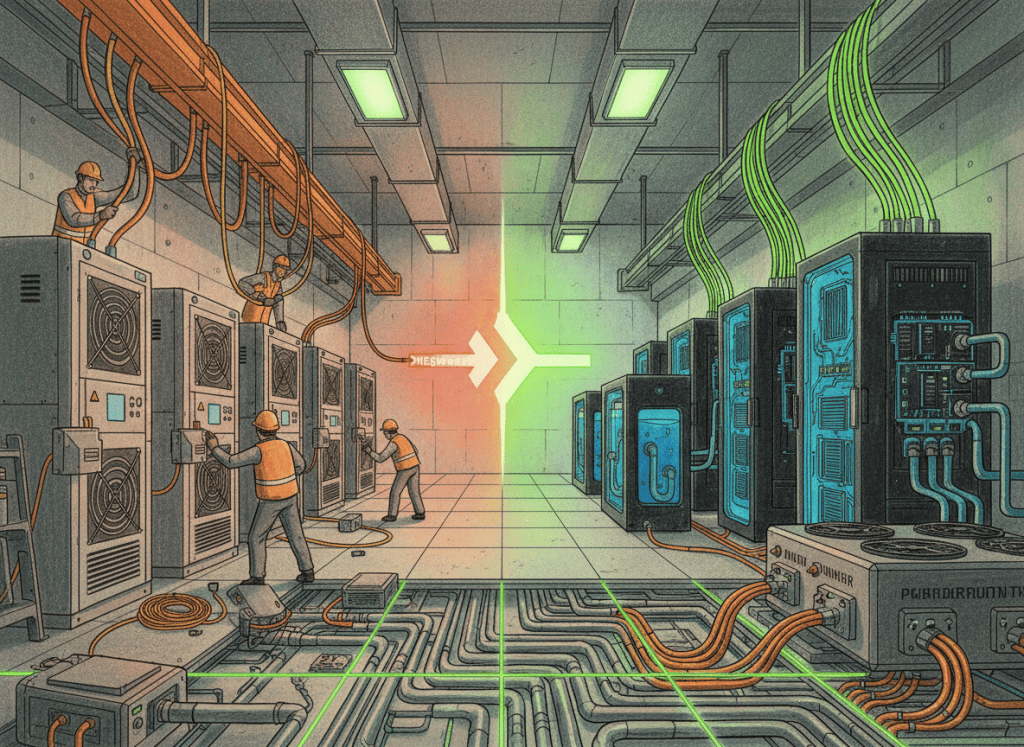
Colored-pencil illustration of Bitcoin mining infrastructure being converted to liquid-cooled AI GPU data center capacity

Some of the largest publicly traded Bitcoin miners are no longer treating artificial intelligence as a side business. They are physically reallocating energized megawatts, retiring ASIC hardware and converting mining campuses into high-density AI and HPC data centers.

A new CoinShares Q2 2026 Bitcoin mining report puts numbers behind that transition. The report estimates the listed mining sector’s weighted-average ex-tax cash cost at about $75,500 per BTC during Q2 and says at least 35 EH/s is scheduled to leave the listed-miner cohort as several operators reduce or exit self-mining.

IREN’s AI revenue overtakes Bitcoin mining

IREN provides one of the clearest examples. Its June-quarter results show AI Cloud Services revenue of $70.5 million, exceeding Bitcoin mining revenue of $66.7 million for the first time.

The transition is also visible on the balance sheet. IREN recorded a $450.4 million non-cash impairment in the June quarter, primarily related to decommissioning Bitcoin mining hardware as sites are converted for AI Cloud growth. It also recorded a $102.1 million reduction in the fair value of assets held for sale and $25.1 million in disposal losses.

CoinShares says IREN expects its transition from mining to AI to be substantially complete by December 31, 2026.

TeraWulf is converting mining infrastructure too

TeraWulf is moving in the same direction. Its Q2 SEC filing records impairment charges related to shutting down mining infrastructure and ceasing associated Bitcoin mining operations to support its transition to HPC. CoinShares reports that two miner buildings at Lake Mariner were retired during the first half of 2026.

CoinShares calculates that HPC lease revenue represented about 71% of TeraWulf’s $44.8 million quarterly revenue. The company mined 179 BTC during Q2, according to its regulatory disclosures.

The scarce asset is increasingly the energized site

This shift explains why Bitcoin mining infrastructure has become strategically valuable to AI developers. A miner may already control land, utility interconnection, substations, transformers, switchgear, fiber access and large blocks of energized capacity. Those assets can take years to reproduce from a greenfield site.

CoinShares estimates that U.S. interconnection queues total roughly 2,600 GW and says data centers account for 87% of ERCOT’s roughly 410 GW large-load queue. In that environment, an existing mining campus with hundreds of energized megawatts can be worth more as a compute platform than the ASICs sitting inside it.

Not every major miner is abandoning SHA-256

The transition is not universal. Bitdeer continues investing heavily in Bitcoin mining hardware and recently announced a Nevada SEALMINER manufacturing facility. CoinShares also identifies operators including MARA, Riot, HIVE and Bitdeer as having retained greater flexibility to continue investing in mining.

That creates two increasingly distinct strategies among major public miners. One group is using its grid connections and data-center campuses to chase AI/HPC economics. Another is continuing to improve SHA-256 efficiency with newer ASIC generations, cheaper energy and larger mining fleets.

Bitcoin ASICs are competing with GPUs for megawatts

At the facility level, this is now a competition over the same fundamental resource: delivered electrical power. Bitcoin ASICs convert megawatts into SHA-256 hashes. AI accelerators convert megawatts into training and inference compute. The economics of each workload determine which machines occupy the building.

CoinShares estimates annualized AI profit at roughly $1.5 million per MW compared with about $0.5 million per MW for Bitcoin mining under the market conditions analyzed in its report. Those are estimates rather than guaranteed returns, and a sustained rise in Bitcoin price or hashprice could change the comparison substantially.

The larger trend is already visible in physical infrastructure. Bitcoin mining helped build a generation of large, power-dense computing campuses. Some of those same substations, transformers and megawatts are now becoming the foundation for the AI buildout.

BitcoinVersus.Tech Editor’s Note:

Support BitcoinVersus.tech with Bitcoin: 3C9o19EH5HSiwEPyCTmEKzxhNCbo2X6TTb

Follow BitcoinVersus.tech on X: https://x.com/BitcoinVersus

BitcoinVersus.tech is not a financial advisor. This media platform reports on financial subjects purely for informational purposes.

22 responses to “Bitcoin Miners Shift Megawatts From ASICs to AI”

  1. […] The permitting pause also arrives as miners themselves diversify. Some public miners are converting power infrastructure to AI and HPC, a trend BitcoinVersus.tech recently examined in Bitcoin Miners Shift Megawatts From ASICs to AI. […]

    Like

  2. […] recently examined the broader shift in Bitcoin Miners Shift Megawatts From ASICs to AI. Barber Lake shows how far that transition can go: instead of monetizing the power connection with […]

    Like

  3. […] development follows the same infrastructure trend BitcoinVersus.tech recently covered in Bitcoin Miners Shift Megawatts From ASICs to AI and Cipher Extends Barber Lake AI Lease Past $9 […]

    Like

  4. […] development follows the infrastructure trend BitcoinVersus.tech recently covered in Bitcoin Miners Shift Megawatts From ASICs to AI and Cipher Extends Barber Lake AI Lease Past $9 […]

    Like

  5. […] The regulatory step is significant because Texas temporarily froze parts of the large-load interconnection process while state officials reviewed the rapidly expanding data-center queue. BitcoinVersus.tech has been tracking that pressure through the Texas data-center permit freeze and the broader shift of mining megawatts toward AI. […]

    Like

  6. […] purchase. The company’s transition toward mixed Bitcoin and GPU compute also fits the broader mining-to-AI infrastructure shift and the changing distribution of global Bitcoin […]

    Like

  7. […] computing toward AI. BitcoinVersus.tech has followed that transition across the industry in miners shifting megawatts from ASICs to AI, while Bitdeer itself continues investing in mining hardware through its U.S. SEALMINER […]

    Like

  8. […] has been tracking that convergence through miners shifting megawatts from ASICs toward AI, Hut 8’s 1 GW Beacon Point development, Soluna’s mining-to-AI expansion and […]

    Like

  9. […] as public miners become more complex infrastructure companies. BitcoinVersus.tech has covered miners shifting megawatts toward AI, Hut 8’s Beacon Point development, Cango adding GPU compute inside a mining campus, Atlantic […]

    Like

  10. […] expansion mirrors a broader industry shift that BitcoinVersus.tech examined in Bitcoin Miners Shift Megawatts From ASICs to AI. The same power, cooling and network expertise developed for large mining fleets can increasingly […]

    Like

  11. […] has tracked the broader movement of mining megawatts toward AI. The Gelephu proposal adds a different version of that trend: instead of merely converting an […]

    Like

  12. […] has already documented miners shifting megawatts from ASICs toward AI, Cango installing GPU compute at a mining site, and Luxor expanding into AI infrastructure. The […]

    Like

  13. […] available energy, cooling and connectivity. That connects with BitcoinVersus.tech coverage of miners shifting megawatts from ASICs to AI, Luxor’s AI infrastructure expansion, BitFuFu’s managed hashrate growth and ASIC efficiency and […]

    Like

  14. […] same lesson appears in BitcoinVersus.tech coverage of miners shifting megawatts from ASICs to AI, Luxor’s AI infrastructure expansion, BitFuFu’s managed hashrate growth and ASIC efficiency […]

    Like

  15. […] coverage has followed related parts of the transition, including miners shifting megawatts from ASICs to AI, Luxor’s AI infrastructure expansion, managed hashrate growth and ASIC efficiency in joules per […]

    Like

  16. […] tradeoff is increasingly visible across the sector. Bitcoin miners are shifting some megawatts from ASICs toward AI, forcing operators to compare the economics of flexible mining loads with longer-duration compute […]

    Like

  17. […] compete for the same power rights, substations and industrial sites. Our earlier report on how miners are shifting megawatts from ASICs to AI showed that electrical infrastructure can become more valuable than the original compute equipment […]

    Like

  18. […] ($1.6 billion) in cash proceeds while reducing debt and expanding toward power generation, AI infrastructure and critical […]

    Like

  19. […] portfolios remain relevant to the AI buildout. BitcoinVersus has tracked the broader transition as miners shift portions of their megawatt portfolios from ASICs toward AI. The underlying constraint in both industries is increasingly the same: usable power delivered on a […]

    Like

  20. […] is central to the industry’s current transition. BitcoinVersus previously examined why miners are shifting megawatts from ASICs toward AI. The new 75 EH/s estimate puts a compute number on the physical side of that […]

    Like

  21. […] is the same thesis BitcoinVersus covered in Bitcoin Miners Shift Megawatts From ASICs to AI. Building a new hyperscale data-center interconnection from scratch can take years. A Bitcoin mine […]

    Like

  22. […] shift is part of the wider trend BitcoinVersus covered in Bitcoin miners shifting megawatts from ASICs to AI. Mining sites already control something AI developers urgently need: energized land, substations, […]

    Like

Leave a Reply