NVIDIA Isaac ROS 5.0 Brings AI Agents Into Robot Development

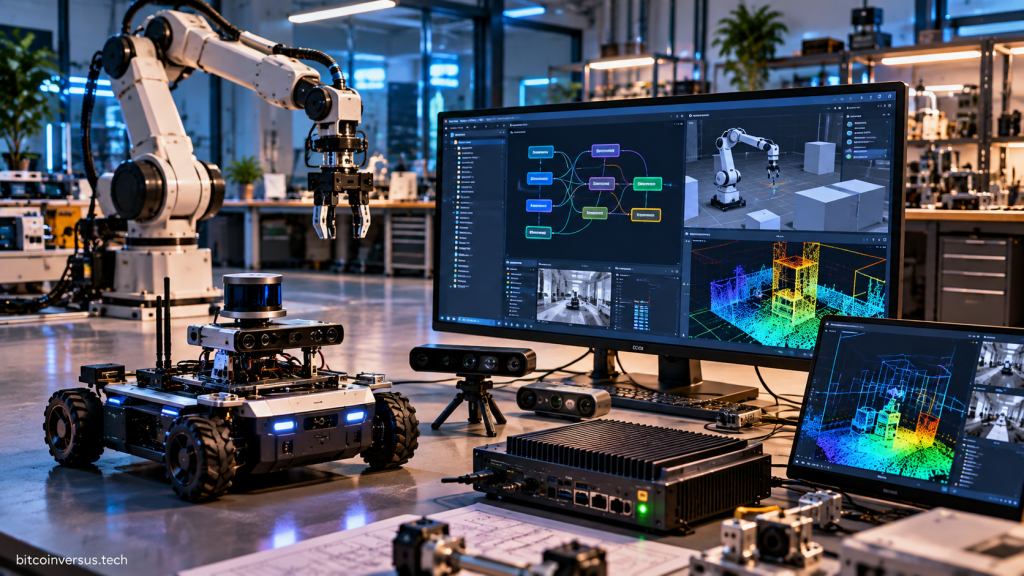
Illustration of an AI robotics development lab with robot arms, mobile robots, edge computers and perception software

NVIDIA released Isaac ROS 5.0 on September 22, bringing AI-agent workflows into the open-source ROS robotics ecosystem while expanding GPU acceleration across Jetson-powered robots.

The release arrived at ROSCon in Toronto and targets a practical problem in physical AI: developers need to build increasingly complex perception and manipulation software while also keeping those workloads fast enough to run on real robots.

AI agents can now help build robot software

Isaac ROS 5.0 adds agent-ready documentation and reusable skills that allow AI coding agents to assist with setup, migration and robotics workflows. NVIDIA says a new FoundationStereo fine-tuning skill can help adapt stereo-perception models to a developer’s cameras and environment.

The embedded NVIDIA Developer video is in English and demonstrates Isaac ROS acceleration on Jetson-class robotics hardware, so translated voice audio is not required.

FoundationPose runs up to 5.5 times faster

NVIDIA says the new agent-ready FoundationPose inference library can perceive and track the position and orientation of objects up to 5.5 times faster. Pick-and-place is also available as a standalone agent-ready skill combining detection, depth estimation and pose output.

The release adds ROS Lyrical and Ubuntu 24.04 support. NVIDIA also contributed a standard data-handling interface to ROS designed to improve movement of data across computing hardware, with CUDA providing a GPU-accelerated implementation.

Robot makers are already integrating Isaac ROS

Universal Robots is using Isaac ROS in its AI Accelerator SDK. ROBOTIS is integrating it into the AI Worker robot for vision-guided picking, placement and alignment. FieldAI is integrating Isaac ROS on Jetson devices for robot foundation models that can run locally without relying on cloud connectivity.

Noble Machines is also using Isaac ROS on Jetson to accelerate development of general-purpose industrial robots. Together, these deployments show how edge AI hardware and open robotics software are converging into a common physical-AI development stack.

Free and open source

Isaac ROS 5.0 is available now as free, open-source software. NVIDIA says the broader ROS ecosystem includes nearly 1.3 million users, giving the release a large developer base for GPU-accelerated robotics applications.

Sources: NVIDIA’s September 22, 2026 Isaac ROS 5.0 release materials and NVIDIA Developer technical documentation. Performance figures are NVIDIA-reported and may vary by robot, model and hardware configuration.


BitcoinVersus.Tech

Advertisement: Follow BitcoinVersus.Tech for independent coverage of Bitcoin, mining hardware, artificial intelligence, robotics, data centers, semiconductors, energy, gaming and emerging technology.

BitcoinVersus.Tech Editor’s Note & Disclaimer:
We volunteer daily to ensure the credibility of the information on this platform is Verifiably True. BitcoinVersus.tech provides news, technical analysis and educational information and does not provide financial or investment advice. Verify technical specifications and performance claims independently before making purchasing, deployment or investment decisions. If you would like to support to help further secure the integrity of our research initiatives, please donate here: 3C9o19EH5HSiwEPyCTmEKzxhNCbo2X6TTb

Related BitcoinVersus.tech coverage: Qualcomm PickNik robotics · Agility Digit 5 · PAL Robotics TIAGo Pro · QBit robot SoC

22 responses to “NVIDIA Isaac ROS 5.0 Brings AI Agents Into Robot Development”

  1. […] has recently followed adjacent work involving programmable computing architectures, AI assisted development and high performance computation. Source: the specialist LifeWiki […]

    Like

  2. […] BitcoinVersus.tech coverage: Qualcomm PickNik robotics · NVIDIA Isaac ROS 5 · PAL Robotics TIAGo Pro · 5 million industrial […]

    Like

  3. […] BitcoinVersus.tech coverage: Agility Digit 5 · Qualcomm PickNik robotics · NVIDIA Isaac ROS 5 · PAL Robotics TIAGo […]

    Like

  4. […] makes the experiment a useful companion to BitcoinVersus.tech’s coverage of NVIDIA Isaac ROS 5.0, QBit’s robot “cerebellum” chip and Qualcomm’s deeper move into […]

    Like

  5. […] BitcoinVersus.tech coverage: Agility Digit 5 · Qualcomm PickNik robotics · NVIDIA Isaac ROS 5 · PAL Robotics TIAGo […]

    Like

  6. […] Related BitcoinVersus.tech coverage: Qualcomm PickNik robotics · Agility Digit 5 · Samsung AI-RAN · NVIDIA Isaac ROS 5 […]

    Like

  7. […] BitcoinVersus.tech coverage: Agility Digit 5 · Qualcomm PickNik robotics · NVIDIA Isaac ROS 5 · Industrial […]

    Like

  8. […] recently covered NVIDIA Isaac ROS 5.0’s agentic robotics tools. The Flexiv integration shows the other side of that software push: a specific force-controlled […]

    Like

  9. […] That approach overlaps with the wider shift toward increasingly data-hungry robot policies. BitcoinVersus.tech recently covered Qualcomm’s move deeper into robotics software through PickNik, Aeva and LG Innotek moving 4D LiDAR toward robot production, and NVIDIA Isaac ROS 5.0 bringing AI agents into robot development. […]

    Like

  10. […] has been tracking in low-power physical-AI acceleration, robot-learning infrastructure, NVIDIA’s Isaac ROS 5.0 robotics stack and hardware isolation for autonomous AI […]

    Like

  11. […] software. BitcoinVersus.Tech recently covered Qualcomm expanding into robotics through PickNik, NVIDIA bringing AI agents into Isaac ROS 5.0, and XDOF scaling robot-training data. Intrinsic Core addresses a different layer: the reusable […]

    Like

  12. […] BitcoinVersus.Tech recently covered Intrinsic open-sourcing its industrial robotics stack, NVIDIA bringing AI agents into Isaac ROS 5.0, and Qualcomm moving deeper into robotics through PickNik. Gen 7 attacks the same problem from the […]

    Like

  13. […] edge angle also overlaps with NVIDIA Isaac ROS 5.0 bringing AI agents into robot development, where deployment quality depends on more than model intelligence alone. Runtime boundaries, […]

    Like

  14. […] same trend is appearing higher in the robotics software stack. NVIDIA Isaac ROS 5.0 is expanding AI-agent tooling for robot development, while the Berkeley project takes a […]

    Like

  15. […] physical deployment is increasingly important in robotics. BitcoinVersus.Tech recently covered how NVIDIA Isaac ROS 5.0 brings AI agents into robot development, while Apptronik has highlighted the hardware bottlenecks facing humanoid production. Eni’s […]

    Like

  16. […] open-source humanoid, Apptronik’s warning about the U.S. humanoid hardware supply chain, and NVIDIA Isaac ROS 5.0 bringing AI agents deeper into robot development. REK is taking many of the same advances in actuators, balance, teleoperation and control systems […]

    Like

  17. […] recently covered NVIDIA Isaac ROS 5.0 and agentic robotics tooling, which reflects the same architectural trend: perception, motion control and higher-level reasoning […]

    Like

  18. […] same systems-level trend is visible in NVIDIA Isaac ROS 5.0 bringing AI agents deeper into robot development. The battle is shifting from “can this robot move?” toward “can a software layer make many […]

    Like

  19. […] NVIDIA’s Isaac ROS 5.0 agent tooling shows the same architecture moving into robotics, where code generation has to meet physical-system […]

    Like

  20. […] has also covered NVIDIA Isaac ROS 5.0 bringing AI agents deeper into robot development. Unitree’s world-action approach attacks the problem from another layer: instead of only giving a […]

    Like

  21. […] chain. For robots, precision actuators may become one of the defining infrastructure layers beneath robot AI software, vision systems, batteries, compute, and safety […]

    Like

  22. […] actuators at 40–60% of total BOM cost, followed by sensing and perception at roughly 10–20% and compute/control at about 10–15%. Schaeffler, one of the major motion-technology suppliers moving into humanoids, […]

    Like

Leave a Reply