OpenAI Launches Dots, Always-On AI Agents That Work Across Apps

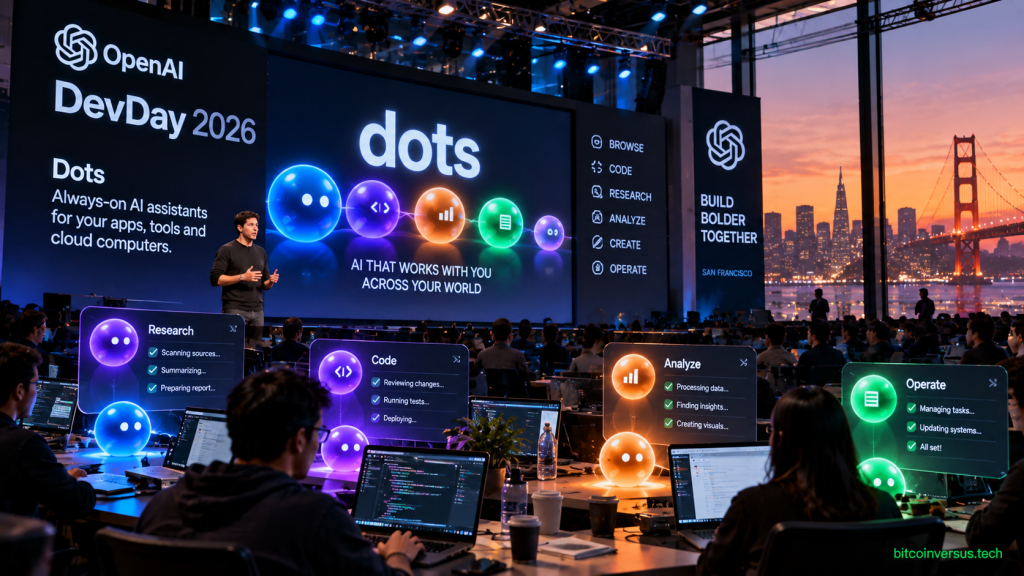
Illustration of OpenAI DevDay 2026 introducing dots, always-on AI assistants working across apps and cloud computers

OpenAI used DevDay 2026 to launch dots, a new class of always-on AI agents designed to keep working across apps, projects and cloud computers instead of waiting for a user to start each task manually.

During the company’s annual developer event in San Francisco, OpenAI presented dots as persistent assistants that can pursue goals, carry context across work, and hand specialized jobs to tools such as Codex and ChatGPT Work. A same-day social post from Digital Trends highlighted the shift from chatbots toward agents that can investigate, build and act across thousands of connected applications.

Digital Trends highlighted OpenAI’s dots launch as the company pushes AI beyond conventional chat into persistent agents.

Dots are designed to keep projects moving

Unlike a conventional chat session, a dot is intended to remain available over time. Users can give it a goal, set boundaries for what it may do independently, and let it continue working until it needs review, approval or more information.

Independent reporting from the launch says dots are powered by GPT-6 Astra and can work across services including Slack and Microsoft Teams while using OpenAI tools such as Codex and ChatGPT Work. The system is positioned first toward professional and enterprise users rather than as a mass-market consumer assistant.

That puts dots into direct competition with systems such as Meta’s Muse AI agent and a growing class of assistants built to operate continuously rather than answer one prompt at a time.

OpenAI’s own keynote shows the agent model in action

OpenAI’s official DevDay keynote demonstrates dots alongside more than 20 product announcements. The video is in English and is published by OpenAI’s official YouTube channel.

OpenAI’s official DevDay 2026 keynote includes the launch and demonstration of dots.

The agent race is moving from tools to operating environments

Persistent agents change the software model because they need permissions, memory, application access and a place to execute tasks. BitcoinVersus.Tech recently covered Microsoft turning Copilot into an AI operating layer for work, another sign that agent platforms are becoming environments rather than isolated assistants.

The more autonomy these systems receive, the more important control mechanisms become. BitcoinVersus.Tech also recently examined NVIDIA’s hardware-watchdog approach to autonomous-agent safety, which tackles the same broader problem from the infrastructure side.

OpenAI says users can define permission rules and approval boundaries for dots. That design reflects a basic tradeoff in autonomous software: the assistant becomes more useful as it gains access to more systems, but every additional permission also increases the importance of monitoring, review and secure isolation.

Why dots matter

Chatbots made AI conversational. Dots represent the next step toward AI systems that remain present while work continues around them. Instead of treating every request as a fresh interaction, the agent can maintain project context, continue tasks in the background and return when a decision is needed.

That does not make the system fully autonomous. Human approvals, application permissions and operating limits remain central to the product. But the launch shows where major AI platforms are heading: from answering questions toward managing ongoing work.


BitcoinVersus.Tech

Advertisement: See the BitcoinVersus.Tech X post below for the current Bitaxe mining-hardware promotion.

BitcoinVersus.Tech mining-hardware advertisement.

BitcoinVersus.Tech Editor’s Note:

We volunteer daily to ensure the credibility of the information on this platform is Verifiably True. If you would like to support to help further secure the integrity of our research initiatives, please donate here: 3C9o19EH5HSiwEPyCTmEKzxhNCbo2X6TTb

BitcoinVersus.tech is not a financial advisor. This media platform reports on financial subjects purely for informational purposes.

19 responses to “OpenAI Launches Dots, Always-On AI Agents That Work Across Apps”

  1. […] treats agent behavior as software architecture rather than a single prompt, while OpenAI’s always-on Dots agents push stateful automation across applications. More recently, NVIDIA’s TensorRT Model Connect work […]

    Like

  2. […] distinction matters as companies move toward systems resembling the always-on AI agents now spreading across workplace software. BitcoinVersus.Tech has also watched firms push agents into […]

    Like

  3. […] agents are becoming persistent workers rather than chat windows. BitcoinVersus recently covered OpenAI’s move toward always-on agents working across applications. Give that class of software credentials, tools and time, and “permission” becomes a […]

    Like

  4. […] coverage of always-on AI agents working across applications showed why operational boundaries are expanding: an agent can move through multiple services during […]

    Like

  5. […] of a broader move toward agents that persist across sessions. BitcoinVersus.Tech recently covered OpenAI’s Dots as always-on agents that work across apps. Team Bots takes a different route by making the persistent context explicitly shareable across a […]

    Like

  6. […] transition across technical fields. OpenAI and Synopsys are using AI inside chip-design workflows, OpenAI’s Dots push agents toward persistent multi-step work, and D-Wave is exposing error-aware quantum simulation to developers. The common thread is that […]

    Like

  7. […] same organizational idea also appears in persistent AI agents that coordinate work across applications, while AI-assisted chip design shows domain-specific models entering highly technical engineering […]

    Like

  8. […] a potential control layer for increasingly autonomous software. BitcoinVersus.Tech recently covered OpenAI’s always-on Dots agents, where the value of an agent depends not only on what it can generate but on whether it can […]

    Like

  9. […] more broadly when the marginal cost of each action drops. BitcoinVersus.Tech recently covered OpenAI’s Dots agents, where always-on systems depend on exactly this kind of scalable model […]

    Like

  10. […] trend fits BitcoinVersus.tech’s recent coverage of OpenAI’s always-on Dots agents. Software that keeps working after the user stops typing naturally creates more model calls, more […]

    Like

  11. […] recently covered OpenAI’s Dots as always-on agents that can work across applications. Space gives that model a shared home: rather than an agent continuously operating against […]

    Like

  12. […] while OpenAI also pushes toward persistent autonomous software. BitcoinVersus.Tech recently covered OpenAI’s Dots, always-on agents designed to work across applications. If assistants increasingly research, compare, create and act on behalf of users, commercial […]

    Like

  13. […] gets even more interesting when the assistant becomes an agent. BitcoinVersus.Tech has also covered OpenAI’s Dots and the move toward always-on AI agents. Once software is researching, comparing and acting for people, the commercial battlefield may […]

    Like

  14. […] became one of the most visible names in the new wave of AI agents because its software is designed to do more than answer a prompt. It can plan and execute […]

    Like

  15. […] than simply buying another name under .com. That fits a company already expanding from models into always-on AI agents, custom silicon and broader software […]

    Like

  16. […] questions to taking actions. BitcoinVersus.Tech has covered AI’s growing advertising layer, OpenAI’s always-on Dots agents, and Google Cloud’s Gemini enterprise […]

    Like

  17. […] developers following OpenAI’s move toward always-on agents, our look at agent harness engineering, and Unity’s Codex development skills, the plugin brings […]

    Like

  18. […] The release extends a fast-moving stack BitcoinVersus.Tech has been tracking: Muse hardware, open-source Muse gadgets, and competing always-on agents such as OpenAI Dots. […]

    Like

  19. […] tour follows a DevDay featuring products such as Dots, ChatGPT Space, and GPT-6.1 Sol. The exchanges offer regional developers a chance to examine those […]

    Like

Leave a Reply