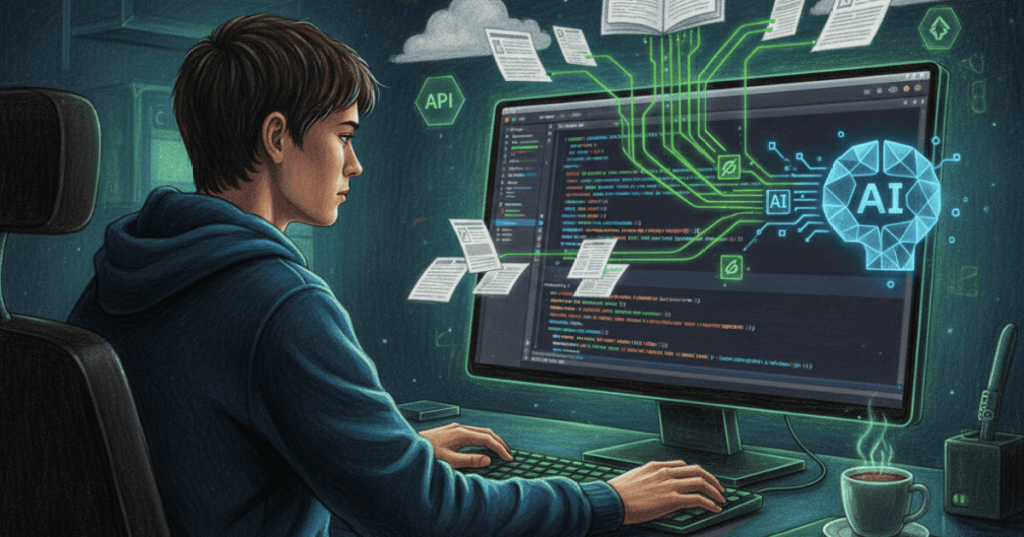
Google is giving AI coding assistants a cleaner way to stop guessing from stale training data. On October 7, Google expanded its Developer Knowledge API ecosystem with a gcloud CLI interface, an official agent skill, an API Explorer, and client libraries so developer tools can pull current Google documentation directly instead of scraping web pages or relying only on what a model learned during training.
The Problem: AI Can Write Code With Yesterday’s Documentation
A coding model can understand Python, Java, Go, TypeScript, and cloud APIs extremely well while still being wrong about a newly renamed method, an updated authentication flow, a deprecated flag, or a product feature released after its training cutoff. That gap matters most in fast-moving ecosystems such as Google Cloud, Firebase, and Android. BitcoinVersus.Tech has already covered how REST APIs depend on exact endpoints, parameters, authentication, status codes, and current documentation. If an AI assistant invents one of those details, syntactically clean code can still fail immediately.
Google Turns Its Documentation Into an API
The Developer Knowledge API is Google’s programmatic source of official developer documentation across Google Cloud, Firebase, Android, and other Google developer platforms. Google says the service supports semantic search, keyword search, intelligent document chunking, full-document retrieval, and grounded question answering. The index is refreshed frequently so an agent can retrieve current technical information with less lag than relying on an LLM’s static training data.
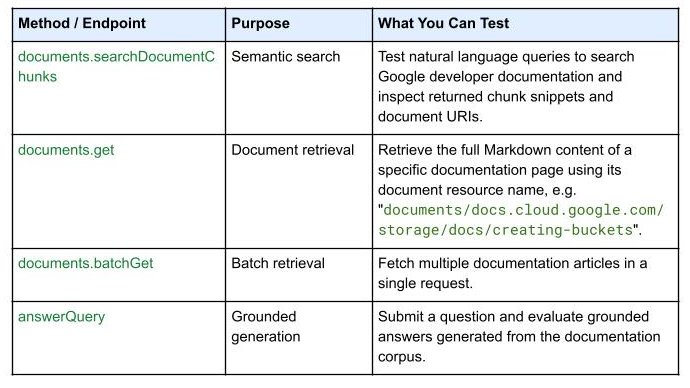
The API exposes operations such as SearchDocumentChunks, GetDocument, BatchGetDocuments, and AnswerQuery. Google says batch retrieval can return up to 20 documents in one request, while the answer endpoint can generate a response grounded in the documentation corpus with structured citation tracking. Client libraries are available for C#, Go, Java, Node.js/TypeScript, PHP, Python, and Ruby.
MCP Connects the Docs Directly to Coding Agents
The most interesting piece is the Model Context Protocol layer. Google’s official agent skill can connect the documentation service to Antigravity, Claude Code, Cursor, GitHub Copilot, and custom agent frameworks. That fits the larger shift toward tool-aware coding agents already visible in AMD Ross and the broader agentic AI production stack: instead of asking a model to remember everything, developers give it tools that can retrieve authoritative information when the task requires it.
Google’s setup command is unusually simple:
npx skills add google/skills --skill retrieving-developer-knowledgeThat skill tells a compatible coding assistant how to query the Developer Knowledge MCP server or fall back to the REST API. In practice, the agent can search small documentation chunks first, fetch full Markdown pages only when needed, and use grounded answers when a direct question is more efficient. That approach reduces context waste compared with dumping entire manuals into a prompt.
The Terminal Gets the Same Live Knowledge
Google also added direct gcloud CLI access. The commands work in Cloud Shell and standard Google Cloud SDK installations on Linux, macOS, and Windows. A developer can query the docs from a terminal, search specific documentation chunks, retrieve a known page, or even pipe an error trace into the service for troubleshooting.
gcloud developer-knowledge answer-query --query="How do I create a BigQuery dataset?"

gcloud developer-knowledge documents search-chunks --query="Firestore transactions"

gcloud developer-knowledge answer-query --query="$(cat error.txt)"
Why This Matters for Coding
AI coding is moving from “write this function” toward longer jobs where an agent reads a repository, chooses APIs, edits files, runs tests, reviews failures, and opens a pull request. The weak point is often not raw code generation; it is technical context. An agent that knows Python but uses a retired Google Cloud option is still wrong. Giving the agent a live documentation tool changes the problem from “hope the model remembers the latest API” to “retrieve the latest API before coding.”
That does not eliminate hallucinations, bad architecture, weak testing, or insecure code. Developers still have to review generated changes and verify behavior. But live documentation grounding attacks one of the most common failure modes directly: confident code based on obsolete or nonexistent product behavior. For coding agents, fresh documentation may become as important as access to the repository itself.
Sources
- Google Developers Blog — Supercharge your development with the Google Developer Knowledge API ecosystem
- Google Developers Blog — Introducing the Developer Knowledge API and MCP Server
- Google MCP — official GitHub repository
BitcoinVersus.Tech
Editor’s Note: BitcoinVersus.Tech reports on programming, artificial intelligence, hardware, semiconductors, networking, energy, robotics, and the tools connecting those systems.
We volunteer daily to ensure the credibility of the information on this platform is Verifiably True. If you would like to support our research initiatives, please donate here: 3C9o19EH5HSiwEPyCTmEKzxhNCbo2X6TTb
BitcoinVersus.tech is not a financial advisor. This media platform reports on technical and financial subjects purely for informational purposes.


Leave a comment