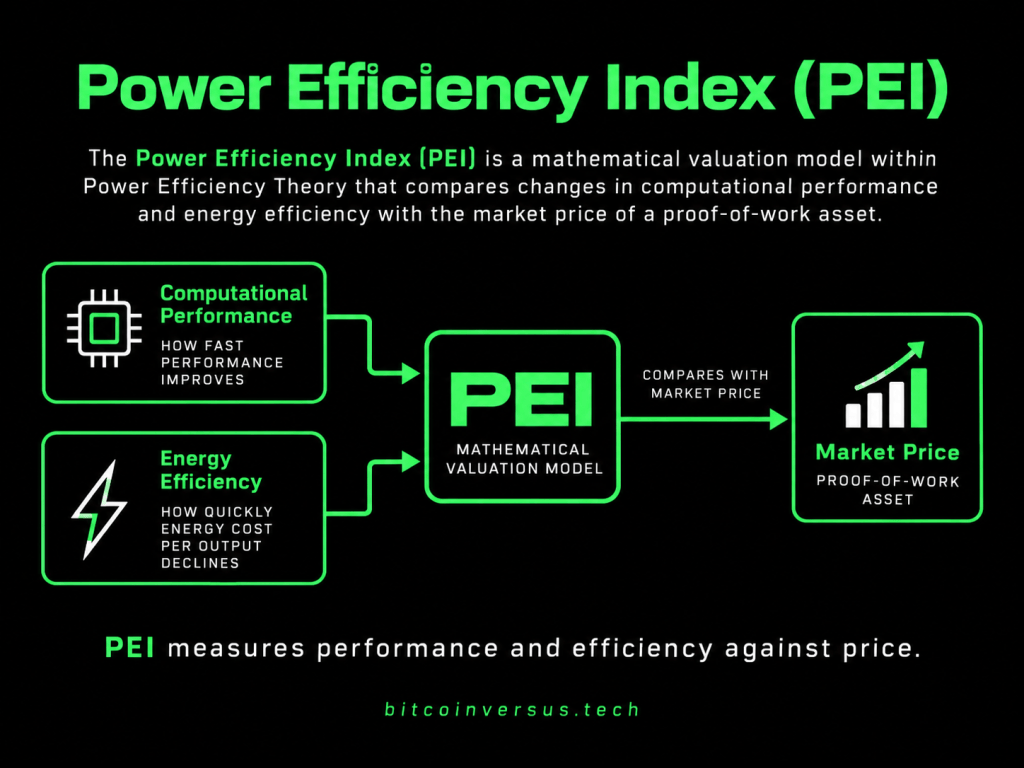
The Power Efficiency Index (PEI) is a mathematical valuation model within Power Efficiency Theory that compares changes in computational performance and energy efficiency with the market price of a proof-of-work asset.
Developed by bitcoinversus.tech, PEI measures the growth in a network’s rate of compute alongside improvements in the energy required per unit of computation.
In its comparative form, the model multiplies an initial physical price by the ratio of current to initial hashrate and the ratio of initial to current energy consumption per unit of compute.
Physical price refers to the lowest observed market price in any declared, complete 48-month window, under the revised November 26, 2026 standard. A one-year low alone is insufficient. See Power Efficiency Theory: The Fundamentals of Physical, Relative and Actual Price for the original algebra, expanded equation, and complete variable definitions.
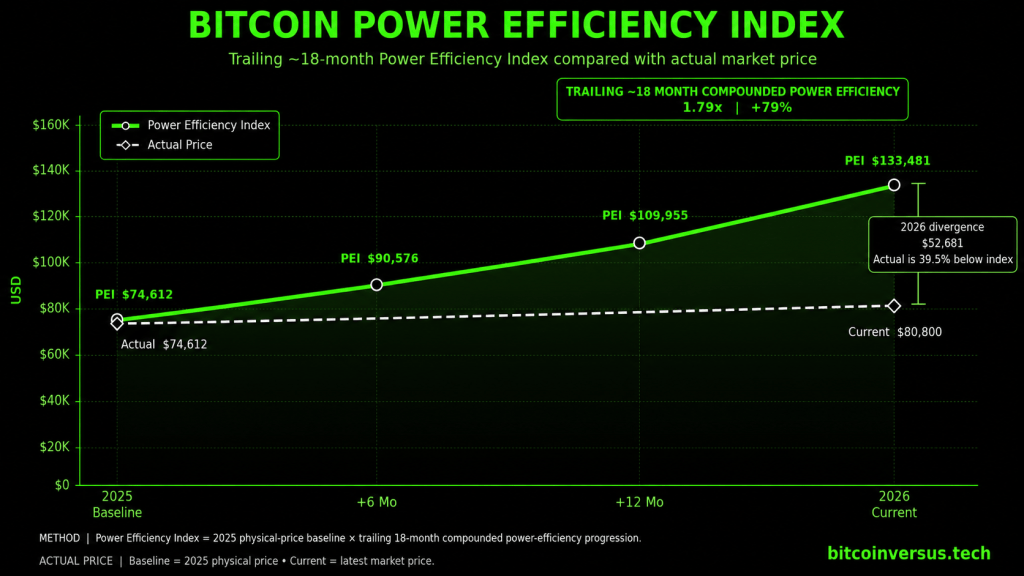
The calculation produces an indicative valuation that rises as computational capacity increases and energy efficiency improves, while declining performance or worsening efficiency can reduce the reading. Market prices below the PEI estimate suggest undervaluation relative to the model; prices above it suggest overvaluation, and prices near it indicate approximate parity.
The difference between market price and the PEI estimate is called PEI divergence.
The current implementation applies to proof-of-work systems and depends on clearly identified computational measurements, representative efficiency data and aligned observation dates.
PEI provides a framework for interpreting valuation differences, with conclusions remaining conditional on the model’s assumptions.
BitcoinVersus.Tech Editor’s Note:
We volunteer daily to ensure the credibility of the information on this platform is Verifiably True. If you would like to support to help further secure the integrity of our research initiatives, please donate here: 3C9o19EH5HSiwEPyCTmEKzxhNCbo2X6TTb
BitcoinVersus.tech is not a financial advisor. This media platform reports on financial subjects purely for informational purposes.


Leave a Reply