OSETC.011: Lockout/Tagout and Energy Isolation

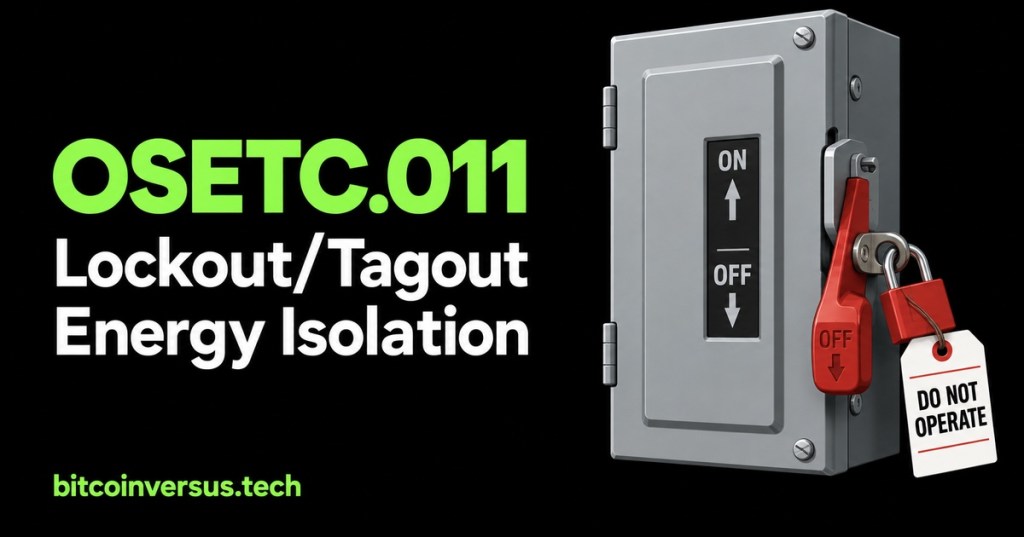
A closed electrical disconnect locked in the OFF position with a warning tag, on a black and neon-green OSETC.011 lesson cover.

Simple explanation: A stopped machine can still hurt someone. A button may stop its motor while electricity remains connected, air stays pressurized, or a raised part can fall. Lockout/tagout helps keep hazardous energy controlled while servicing takes place.

Definition: Lockout/tagout (LOTO) is an energy-control process. Lockout physically secures an energy-isolating device in its safe position. A tag warns that equipment must not be operated. Energy isolation separates equipment from its energy sources.

In OSETC.010: Fuses and Circuit Breakers, we learned about protection against excessive current. This lesson asks a different question: how is equipment made safe for servicing?

Why OFF is not enough

A STOP button controls operation; it does not physically disconnect the energy supply. An emergency stop or software command also cannot serve as the sole means of isolation. A proper isolating device might be a disconnect switch, suitable circuit breaker, valve, or mechanical block.

Look beyond electricity. Compressed air, hydraulic pressure, springs, hot surfaces, rotating parts, and gravity can retain dangerous energy after shutdown. A machine may also have more than one supply. The equipment-specific procedure must identify every relevant source.

Who does what?

An authorized employee is trained to apply the employer’s energy-control procedure for servicing. An affected employee operates the equipment or works nearby and must understand the restrictions. Reading this lesson does not make someone authorized or electrically qualified.

A lock provides physical restraint. A tag communicates a warning; it does not provide that restraint. Do not bypass either or restart equipment under energy control. Where tagout is used instead of lockout, the employer must meet the applicable requirements for worker protection.

Watch the concept in practice

Watch AutomationDirect’s introduction, then use the scenario below to distinguish shutdown, isolation, and verification. The video illustrates general machine LOTO; it does not replace electrical absence-of-voltage verification or an employer’s procedure.

Video: “What is Lockout Tagout?” — AutomationDirect.

Understand the sequence

The employer’s procedure guides notification, shutdown, isolation, application of energy-control devices, control of stored energy, and verification before servicing. It also governs restoration after work. This is a conceptual overview, not a field checklist.

Verification matters: Failure to restart does not prove an electrical circuit is de-energized. Under OSHA 1910.333, a qualified person checks that equipment cannot restart and tests the exposed electrical parts to verify de-energization, including possible backfeed. A locked disconnect alone is not proof that every conductor inside an enclosure is safe.

Restoring service requires checks of equipment and the work area, clearing people, and controlled removal of locks and tags under the applicable procedure. Never remove another worker’s lock on your own initiative.

Paper exercise: a conveyor that looks stopped

Imagine a fictional conveyor with an electric motor, an air-powered pusher, and a raised weight. Its STOP button has been pressed. No one is touching the machine. Answer on paper only; do not operate or open real equipment.

1. Is the stopped belt enough evidence that servicing can begin? 2. Which three energy sources should the procedure address? 3. Does a warning tag physically prevent someone from restoring power?

Answers: 1. No—the visible motion has stopped, but energy control has not been demonstrated. 2. Electrical supply, compressed air, and the weight’s gravitational energy. 3. No—a tag warns; a lock supplies physical restraint at the isolating device. The scenario still requires trained personnel and equipment-specific verification.

Review and sources

Remember three separate ideas: stop operation, isolate and control energy, verify the safe condition. A quiet machine is not evidence that all hazards are controlled.

U.S. references: OSHA 1910.147 addresses hazardous energy in covered machine servicing; OSHA 1910.333 addresses electrical work practices under Subpart S. Their scopes differ. See also OSHA’s training and tag limitations and lockout/tagout guidance. Follow the rules applicable to your workplace and jurisdiction.

18 responses to “OSETC.011: Lockout/Tagout and Energy Isolation”

  1. […] lesson follows OSETC.011: Lockout/Tagout and Energy Isolation. It is a recognition-and-theory lesson; it does not authorize work on energized […]

    Like

  2. […] It does not make energized work acceptable. Use the isolation principles from OSETC.011: Lockout/Tagout & Energy Isolation. […]

    Like

  3. […] is the same principle introduced in OSETC.011: Lockout/Tagout and Energy Isolation: control devices are not substitutes for proper energy […]

    Like

  4. […] Do not permanently bypass a float switch or other safety/control device just to make equipment run. If energy isolation is required, follow the principles from OSETC.011: Lockout/Tagout and Energy Isolation. […]

    Like

  5. […] Before servicing, follow the equipment’s approved energy-control procedure. Isolate electrical energy and pressure energy as required, release or restrain stored energy safely, and verify the safe condition. Review OSETC.011: Lockout/Tagout and Energy Isolation. […]

    Like

  6. […] mode adds reduced motion + enabling controls↓maintenance requiring hazardous-zone access uses lockout/tagout and energy isolation↓verification before entry + controlled reset before […]

    Like

  7. […] pressure sensing; OSETC.018: Interlocks and Permissives Basics establishes operating permissions; OSETC.011: Lockout/Tagout and Energy Isolation establishes the isolation […]

    Like

  8. […] safety: current-loop troubleshooting does not replace electrical energy-control procedures. OSETC.011: Lockout/Tagout and Energy Isolation establishes the isolation boundary for technician […]

    Like

  9. […] opening panels or disturbing energized circuits, follow the isolation boundary established in OSETC.011: Lockout/Tagout and Energy Isolation. A low-voltage analog signal can still be located inside equipment containing hazardous […]

    Like

  10. […] tubing, removing a valve, or reaching into an actuator mechanism, follow the tool procedure and lockout/tagout and energy-isolation requirements: isolate the air source, vent trapped pressure, verify zero or safe pressure, and […]

    Like

  11. […] tag, range, units, wiring, loop power, and required tolerance. Coordinate with operations and apply energy isolation whenever the procedure requires it. Connect a known reference source to the transmitter input and […]

    Like

  12. […] hands-on service, follow the approved lockout/tagout and energy-isolation procedure, isolate all required energy sources, wait the specified discharge time, verify the safe […]

    Like

  13. […] lockout/tagout and energy isolation before hands-on service where hazardous energy exposure […]

    Like

  14. […] Lockout/tagout, usually shortened to LOTO, is the safety process used to keep machinery and equipment from unexpectedly starting, moving, pressurizing, heating, or becoming energized while somebody is servicing it. It is one of the most important ideas in industrial maintenance because a machine that looks “off” can still contain dangerous energy. For the deeper technician lesson, see OSETC.011: Lockout/Tagout and Energy Isolation. […]

    Like

  15. […] to be repeated. In a technical workplace, the reinforced behavior might be following the full lockout/tagout process, documenting a root cause instead of merely clearing an alarm, creating a clean shift handoff, or […]

    Like

  16. […] Before attaching test equipment in a live process, follow the approved work permit and energy-isolation procedure where […]

    Like

  17. […] the work is, the tighter some constraints should be. A technician should not improvise around energy-isolation requirements. But the same technician may have broad freedom in how they organize documentation or sequence […]

    Like

  18. […] Hands-on maintenance begins with the workcell risk assessment and the applicable energy-control procedure. A robot may contain electrical energy, stored mechanical energy, gravity loads, pneumatic or hydraulic pressure, spring forces, tooling hazards, external axes, and process energy. Use the same discipline established in OSRTC.001 and OSETC.011 on lockout/tagout. […]

    Like

Leave a Reply